What Amatic slots cost UK players in 2026 — and which licensed sites make that cost visible
 Available in GB
23 September 2026 · checked against the Gambling Commission’s public register of gambling businesses (CSV download, 18 September 2026)

Anyone searching for the best Amatic online casinos in the UK is really asking a smaller, sharper question: which site will let me play these particular slots under rules I can verify, without the welcome bonus quietly doubling the amount I have to wager before I can withdraw. The Austrian supplier behind Book of Fruits, Royal Dragon and Princess of Pearls is itself licensed here — Amatic Industries GmbH has held a Great Britain remote Gambling Software licence since 27 April 2017 — but that licence covers the games, not the casino. A site still needs its own Gambling Commission remote operating licence before any of those titles can be offered to a player sitting in Manchester, Cardiff or Glasgow. The distinction sounds technical. It is the only thing that decides whether a complaint to the Commission, a GAMSTOP self-exclusion or a £5 stake cap actually applies to your session.
This page closes that gap with the one comparison that matters on a regulated market: the cost. What a spin costs, what a bonus actually demands in turnover, what a stake limit does to a session, what “instant withdrawal” leaves out, and which brands have already proved the rules by being on the register at the date this article is checked. Ten operators are reviewed; every one of them is a current Gambling Commission licensee, and every one of them is described rather than recommended. A player who only cares about which brand runs the best promo is in the wrong place. A player who wants to know what those promos will really take from a £100 deposit is exactly where they need to be.
Table of Contents
- Amatic slots on a phone: how the catalogue survives a small screen
- The licensed UK landscape: ten brands, one register, different parents
- What an Amatic slot is, and where the catalogue actually sits
- Jurisdiction, licence and what “UK-licensed” actually delivers
- GAMSTOP, self-exclusion and the cost of “not on GAMSTOP”
- Cryptocurrency, anonymity and what the licence actually requires on identity
- Deposits, withdrawals and the real cost of “instant” payouts
- Bonuses, free spins and the cost of clearing them
- Betfred — a familiar brand on a current licence
- Jackpotjoy — a slots-led brand under Gamesys Operations
- William Hill — heritage brand, current licence, the cost of size
- kwiff — the smaller operator on a recent licence
- PokerStars — the poker brand on a current licence
- Ladbrokes — heritage sportsbook, casino under the same licence
- Paddy Power — another sportsbook with the same casino cost
- Unibet — the international brand on a current licence
- Virgin Games — the white-label sibling of Jackpotjoy
- Casumo — the casino-first brand on a current licence
- The arithmetic of a welcome bonus in 2026
- Frequently asked questions
Amatic slots on a phone: how the catalogue survives a small screen
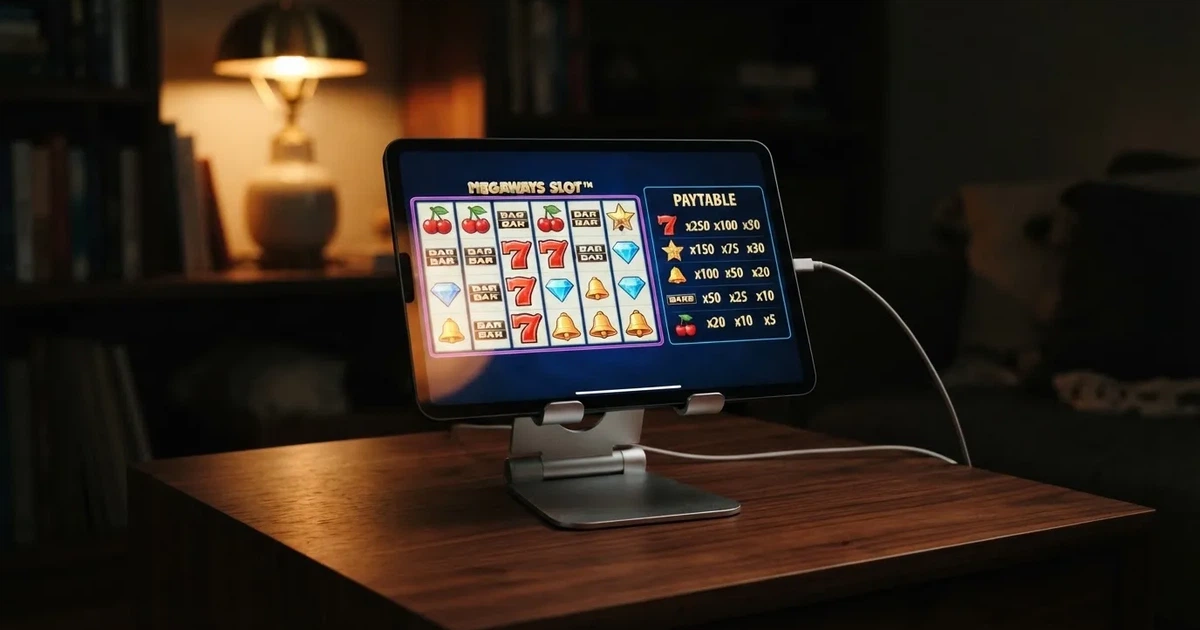
Amatic Industries has been building casino hardware since 1993 and exporting more than 90% of what it produces; the company’s slot range now spans more than 130 titles on its own website, with the software side run out of Traunsteinstrasse 12, 4845 Rutzenmoos in Austria. What that history actually delivers to a player on a 6.1-inch handset is a slot catalogue that was designed in the late 2000s and quietly rebuilt for HTML5 — and the difference between the two is the only thing worth knowing before opening a session on a phone.

The original Amatic games run on Flash, which no current mobile browser supports. The replacement versions load in a standard browser tab without a download, an app install or a separate login, and the file size is small enough that a 4G signal in a city is enough. What the page does not do is duplicate a desktop lobby. Amatic’s mobile build packs the reels, the paytable and a settings cog into the same vertical column, and the spin button stays a thumb’s reach away from the bottom edge — which matters because the Commission has banned auto-play on every slot since 31 October 2021 and capped spin speed at 2.5 seconds. A button that has to be tapped every spin is a button that needs to be in reach. On an Amatic mobile build it usually is.
The cost of this convenience is the same cost every browser-based slot has: the screen real estate shrinks, the paytable goes behind a tap rather than sitting beside the reels, and on titles with twelve or more paylines a player on a small phone has to trust the line indicator rather than count. That is not a complaint unique to Amatic — NetEnt and Play’n GO designs do the same — but it does mean a player who likes to read the rules before they spin will spend more taps on the paytable than they would on a laptop. The flip side is what those taps reveal: Amatic’s games ship without a downloaded client and without the kind of push-notification prompts an app install would require, so a session can be started and stopped without anything persisting on the device afterwards.
In practice this means a phone or tablet player is not looking for a casino with a dedicated “Amatic app” — no major UK brand ships one — but for a casino whose browser build is stable on a long session. A slot that drops a frame every thirty spins is a slot that is costing the player an unmeasured amount in dropped bets. The way to check that, before a deposit, is to load a game in demo mode (where the site offers one) and time the responsiveness for ten minutes. That is the only meaningful test of mobile play on this catalogue.
Key Regulatory Dates
| Date | Regulatory Event |
|---|---|
| 27 April 2017 | Amatic Industries Great Britain Software licence start |
| 7 May 2019 | Mandatory identity verification before play |
| 31 March 2020 | GAMSTOP self-exclusion mandatory |
| 14 April 2020 | Credit card ban |
| 31 October 2021 | Auto-play ban and spin speed cap |
| 9 April 2025 | £5 stake cap (players 25+) |
| 21 May 2025 | £2 stake cap (players 18-24) |
| 31 October 2025 | Mandatory financial limit prompts |
| 19 December 2025 | 10x wagering cap and mixed-product bonus ban |
| 1 April 2026 | Remote Gaming Duty increased to 40% |
The single most useful thing a player can do before any spin on an Amatic title is open the paytable and read it. The supplier’s own site lists more than 130 games and does not publish return-to-player percentages for any of them — a fact the company is not alone in among European land-based slot makers, but one that changes what “checking the maths” means at the level of the individual title. Where a NetEnt or a Play’n GO game ships with a stated RTP printed into the help screen, an Amatic slot typically does not. A player who wants a number has to take it from the casino’s own game-information page, and that page is what the operator chooses to disclose.
What the games do state, every time, is the line structure and the symbol hierarchy. Book of Fruits — the catalogue’s most copied layout — runs a five-reel, three-row frame with ten adjustable paylines and a Book symbol that doubles as both scatter and wild. Royal Dragon runs the same frame with a different scatter mechanic. Princess of Pearls runs a slightly rarer six-reel layout. None of those numbers is hidden behind marketing copy; they are mechanical, and they are stable across every operator that hosts the title, because the game file is the same file. A £0.10 line bet on Book of Fruits at William Hill pays the same combination table as a £0.10 line bet on the same title at Casumo. That is the part of the cost a player can actually check.
What changes between operators is everything around the game: the bonus attached to it, the spin value the casino defaults to, the deposit method that is allowed, and the maximum stake the regulator permits on the player’s account. A 25-year-old player on a regulated site is currently limited to £2 per game cycle; a player aged 25 or over is limited to £5. Both figures came into force during 2025 — £2 on 21 May 2025, £5 on 9 April 2025 — and both are applied per spin rather than per line. That single rule does more to set the real cost of an Amatic session than any RTP figure, because it caps how fast a bankroll can drain on a cold run. A player who would once have bet £10 a spin and lost it in a bad minute is now betting £2 or £5 and losing it across two or five minutes instead. The arithmetic changes; the house edge does not.
Volatility on Amatic’s catalogue runs the range from low (the fruit-and-Bell slots) to medium-high (the Book-of mechanic titles), but the supplier’s site does not publish a volatility tag for individual games either, so a player has to read a session log rather than a help screen to know which kind of slot they are sitting at. A title that pays a small win every few spins costs differently from a title that pays nothing for two hundred spins and then a four-figure return. The price per spin is identical; the variance is not, and the casino’s game-information page will not always tell a player which they have picked.
The licensed UK landscape: ten brands, one register, different parents
The comparison the page is built around sits below. Every brand is a current entry on the Gambling Commission’s public register of gambling businesses; every licence number is one a reader can look up on the Commission’s own site by searching the licence holder. Several of these brands sit under the same parent company — Virgin Games is a white-label of Gamesys Operations Limited, the same licensee that runs Jackpotjoy, so the two are not independent operators even though they carry different trading names. The register’s domain list tracks each website against the licence account that runs it, and the domain status (Active, Inactive or White Label) is part of what a player can verify before a deposit. The table below is not a ranking. It is the landscape as the Commission records it.
Landscape of licensed UK casinos reviewed against the Amatic subject
| Brand | Licence holder and GB remote casino licence | Domain status | Subject support |
|---|---|---|---|
| Betfred | Petfre (Gibraltar) Limited — 039544-R-319290-010 | Active | — |
| Jackpotjoy | Gamesys Operations Limited — 038905-R-319430-022 | Active | — |
| William Hill | WHG (International) Limited — 039225-R-319373-015 | Active | — |
| kwiff | Eaton Gate Gaming Limited — 044448-R-323408-017 | Active | — |
| PokerStars | Stars Interactive Limited — 039108-R-319334-026 | Active | — |
| Ladbrokes | LC International Limited — 054743-R-330863-014 | Active | — |
| Paddy Power | PPB Games Limited — 039411-R-319335-010 | Active | — |
| Unibet | Platinum Gaming Limited — 045322-R-324275-019 | Active | — |
| Virgin Games | Gamesys Operations Limited — 038905-R-319430-022 | White Label | — |
| Casumo | Recro Limited — 061549-R-336718-002 | Active | — |
The “—” in the right-hand column is not shorthand for “this brand does not carry Amatic”. It is shorthand for “the public register does not record which software providers’ games a domain hosts, and the research that fed this page did not find a source that confirms Amatic’s catalogue on or off any of these ten brands.” That is the honest position. A player who wants to know whether Book of Fruits is on the site they have just opened must look at the site’s own lobby — not at this page, not at the register, not at any third-party listing that claims to know.
What the table does establish, by the licence numbers alone, is that each of these ten brands has cleared the basic regulatory threshold: an active Commission operating licence, a real licence holder (not a white-label slot) on most of them, and a domain the Commission still recognises as live. That is the entry condition for the rest of this page. The remaining sections treat what the licence does not fix.
What an Amatic slot is, and where the catalogue actually sits
Amatic Industries GmbH is an Austrian gaming supplier founded in 1993 and headquartered at Traunsteinstrasse 12, 4845 Rutzenmoos, in the same building complex the company has occupied since its early manufacturing years. The product range is broader than the slots alone: gaming cabinets for casino floors, multiplayer systems, server-based video lottery terminals, jackpot solutions, casino management systems, and the online division whose titles a UK player actually meets. The company is a member of Leitbetriebe Austria — a body that recognises leading Austrian businesses — and states that more than 90% of its production is exported. Roughly thirty years of operation does not, by itself, tell a player much about the quality of an HTML5 slot built in the last decade. What it tells them is that the supplier has survived three cycles of hardware turnover, two of which killed most of its Austrian competitors, and is still shipping product into regulated European markets.
The online catalogue is the slice of that history a UK player can reach. Amatic’s own site lists more than 130 slot titles, with Book of Fruits, Royal Dragon and Princess of Pearls among the most recognised — a fruit-machine layout, an Asian-themed five-reel game, and a pearl-themed six-reel game respectively. The supplier does not publish RTP figures for these games on its own site; that information is left to the operator that hosts them, which is unusual but not unique, and it leaves a player who wants the maths reading the casino’s game-info panel rather than the maker’s marketing. The titles themselves share a visual grammar — a small set of fruit and gem symbols, a single premium symbol, and a scatter that tends to double as a wild — and that shared grammar is what makes the catalogue feel coherent even to a player who only meets one or two of the games.
The supply relationship with the UK market sits on a different document. Amatic Industries GmbH holds an active Great Britain remote Gambling Software licence from the Gambling Commission, account number 47992, in force from 27 April 2017. A Gambling Software licence is not the same as a remote casino operating licence: it authorises the holder to supply games to UK-licensed operators, but it does not itself authorise the holder to take bets from UK players. A casino that wants to offer Amatic titles must hold its own operating licence; Amatic must hold its software licence. Both are visible on the Commission’s public register, and both must be current. The 2017 date is the date Amatic became eligible to integrate with UK operators at all.
What this means for the cost of playing an Amatic slot on a regulated UK site is straightforward. The game itself is one file, running on one maths model, regardless of which of the ten brands in this page hosts it. The price the player pays on each spin is the same. The price the player pays around the spin — the welcome bonus, the deposit method, the withdrawal window, the stake cap applied to their age band — is set by the operator and the regulator, not by the supplier. The two cost lines are easy to confuse and impossible to compare, which is why this page separates them.
Jurisdiction, licence and what “UK-licensed” actually delivers
Every online casino that takes a bet from a player in Great Britain needs a Gambling Commission licence; since the Gambling (Licensing and Advertising) Act 2014 the rule applies to operators based anywhere in the world, not just those with a British office. A Curaçao or Malta licence is not a substitute: it does not authorise the holder to take bets from a person sitting in Birmingham, and an operator running on such a licence alone is committing an offence under section 33 of the Gambling Act 2005 by accepting that customer. The Commission itself does not have the power to block ISPs in the way the Spanish or Italian regulators do — its enforcement toolkit runs to cease-and-desist notices, search-engine delisting, and payment-and-hosting referrals — but the absence of a block does not change the legal position for the operator.
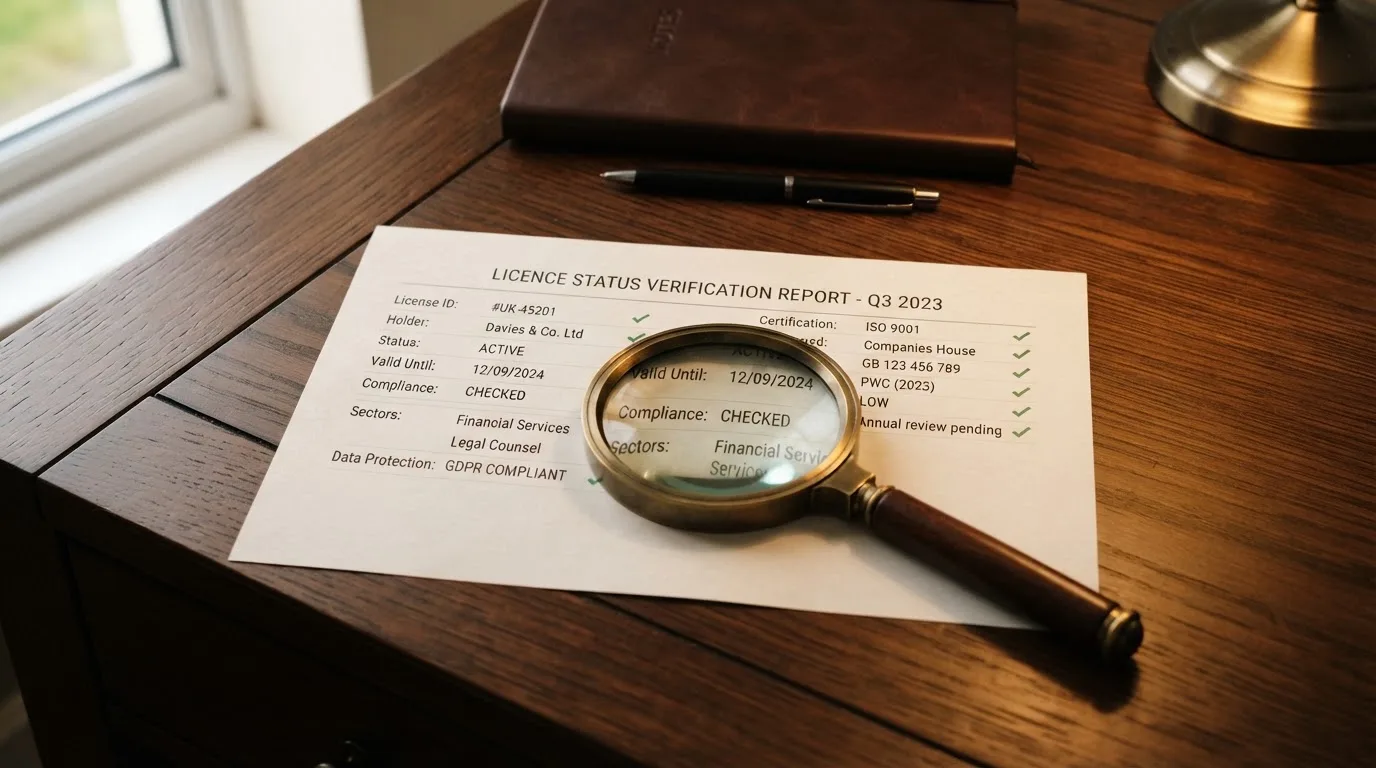
The register that enforces this is the same register the table in the landscape section is built from. The Commission’s public register of gambling businesses lists every active licence holder, every account number, every licence number and every domain the holder runs. On 18 September 2026 it carried 139 businesses holding an active remote casino operating licence — and the register itself can be downloaded as a CSV or Excel file, so a player who wants to check whether the brand in front of them is licensed does not need to take the casino’s word. They can pull the file and search it. The remote casino licence number follows a fixed shape — an account number, the letter “R” marking the remote licence, a serial, and a suffix — and that shape is the easiest thing to verify by eye.
What the licence delivers to a player is also a fixed list. Minimum age 18. Name, address and date of birth verified before the first deposit or any play — a rule that has been in force since 7 May 2019 and that closes the door on the “deposit first, verify later” pattern that used to be common. GAMSTOP self-exclusion, which has been a mandatory condition of every online licence since 31 March 2020 and which cannot be cancelled early once activated. Auto-play banned since 31 October 2021; spin speed capped at 2.5 seconds; losses disguised as wins banned in the same package. From 28 February 2025 a financial vulnerability check runs at £150 net deposits in a rolling 30 days, using public data only. Each of these rules is a cost in time or convenience, and each is the price of a market where the regulator can punish the operator that breaks them. A site that delivers none of them is a site running outside the regime, and the section on offshore play below is the place to read what that costs.
The Commission’s domain list is the second half of the public test. Each domain is recorded with a status: Active, Inactive or White Label — and the white-label designation means the site trades under another company’s licence rather than holding its own. On 18 September 2026 the register held 1065 active and 361 white-label domain entries, and the white-label figure is worth pausing on. A white-label domain is not a separately-licensed operator; it is a trading name on top of a licence the player cannot see at the brand level. The complaint route, the ADR route and the GAMSTOP coverage still apply, but they run through the licence holder, not the white-label. Players who care about who they are actually dealing with should look past the brand name to the licence holder.
What this section does not do is promise that a licensed site is a good site. The licence is a minimum condition, not a quality mark. Ten brands meet it; the rest of the page is about what they then ask a player to pay.
GAMSTOP, self-exclusion and the cost of “not on GAMSTOP”
GAMSTOP is the national online self-exclusion scheme, free to use and available to any player resident in Great Britain. Once a player registers, every Gambling Commission-licensed online operator is required to block that player from opening a new account, depositing or even accessing their existing account for the period chosen. The minimum period is six months, the standard options are six months, one year and five years, and the exclusion cannot be cancelled early regardless of what the player requests later. GAMSTOP has been a mandatory condition of every online licence since 31 March 2020, so any site that takes bets from a self-excluded player is in breach of its licence conditions.
The phrase “Amatic casinos not on GAMSTOP” is doing real work in search, and what it is selling is straightforward: a way around the rule. A site that markets itself as “not on GAMSTOP” is, by definition, not a Gambling Commission licensee, and a site that is not a Commission licensee cannot lawfully take bets from players in Great Britain. The Amatic catalogue is unaffected. The slot still runs the same maths. What changes is everything around the slot: there is no Commission complaints route, no approved ADR, no automatic GAMSTOP block, and no obligation on the operator to honour a self-exclusion request. The player is also taking on the entire credit risk of an entity outside UK enforcement — winnings disputes, withdrawal delays and identity verification hold-ups are the player to resolve alone.
The cost of “not on GAMSTOP” is therefore not a fee. It is the removal of every protection the licence funds. A player who has self-excluded and is searching for a route back into the same catalogue will find one. The same player will also find that they cannot complain to the Commission when a withdrawal stalls, and cannot enforce a deposit limit, and cannot ask an ADR to arbitrate. That is the trade. A player who has not self-excluded and is searching for a “not on GAMSTOP” site for speed or anonymity is paying the same price — the absence of protection — without the offset of a problem to solve. The regulated sites reviewed below are slower on the deposit side because the verification step is real, and they cost the player less on the dispute side because the licence is the dispute mechanism.
The wider player-protection layer sits below GAMSTOP. The National Gambling Helpline, run by GamCare, is the free phone and live-chat service that any UK player can use regardless of where they gamble. GambleAware funds research, treatment and the wider prevention effort. Reality checks — a pop-up reminding the player how long they have been in a session — are mandatory on every slot from a licensed site. Time-out, a shorter cooling-off than GAMSTOP self-exclusion, is offered by every operator in the table. None of these costs the player anything; all of them disappear the moment the player moves to an offshore brand.
Cryptocurrency, anonymity and what the licence actually requires on identity
Amatic slots accept cryptocurrency at offshore brands, and the marketing around that fact is built on a simple pitch: deposit fast, withdraw fast, do not upload a passport. The pitch survives because the licence rules on a regulated UK site run in the opposite direction. Since 7 May 2019 every Gambling Commission-licensed online casino has been required to verify a player’s name, address and date of birth before the first deposit or any play, and the rule has not loosened since. A player who is asked for a passport photo and a utility bill at the deposit stage is being asked for the document set that every licensed operator in the table above will ask for, in roughly the same order, for the same reason. The reason is not administrative friction. It is the licence condition.
Credit cards have been banned for gambling since 14 April 2020, and the ban extends to credit cards funded through e-wallets, which closes the obvious workaround. Cryptocurrency is not a credit card and is not, in itself, banned — but a regulated operator that accepts Bitcoin or Ethereum still has to satisfy the verification rule on the player behind the wallet, and that means the same documents are required at withdrawal as at deposit. The cost of using crypto at a licensed site is therefore the same cost as using a debit card: identity verified, source of funds checked at the £150 net-deposit trigger, and a withdrawal that cannot be processed until the check is complete. The “instant” in “instant withdrawal” applies to the payment rail, not to the verification step that gates it.
The offshore pitch works because the verification step is the most complained-about part of any UK-licensed casino. It slows a first deposit by minutes or hours, it sometimes asks for a second document, and it occasionally rejects a player on the basis of a name mismatch the player has to resolve by email. None of that friction is accidental. It is the mechanism the regulator uses to enforce age verification, GAMSTOP self-exclusion and the financial vulnerability checks that run at £500 in cumulative deposits in a rolling 30 days from 28 February 2025. The player pays the time cost; the operator pays the licence risk if it skips the step.
A player who genuinely wants to play Amatic slots with Bitcoin has two paths, and only one of them is regulated. The regulated path is a licensed operator that accepts crypto on the deposit side, verifies identity on the player side, and pays withdrawals back to the same wallet after the check. The unregulated path is an offshore brand that does none of those things and operates outside the Commission’s enforcement. The Amatic catalogue does not change between the two paths. The protection layer does. Anonymity at the deposit step is bought at the price of anonymity at the dispute step, and the player is the one settling every difference that follows.
Deposits, withdrawals and the real cost of “instant” payouts
A regulated UK site accepts a narrower range of payment methods than the offshore market, and the narrowness is the point. Debit cards are accepted. Bank transfers are accepted. A small set of e-wallets — PayPal among them — are accepted, though not by every brand in the table. Prepaid cards are accepted, and the licence condition does not treat them differently from debit cards. Credit cards are not accepted; credit-funded e-wallet deposits are not accepted; cryptocurrency is accepted where the operator offers it and is processed under the same identity rules as everything else.
The verification step is the part of the deposit flow that costs a player the most time, and the cost varies by operator. The lighter sites verify at registration using a single document and an automated check, and the player is depositing within minutes. The heavier sites defer the full check until the first withdrawal, which means the player deposits and plays immediately but waits longer for the first payout. Neither pattern is a quality mark; both are choices the operator makes within the licence rules, and the practical difference is whether the friction happens at entry or at exit.
Withdrawal speed is the metric every comparison page tries to compare, and on a regulated site the answer is more honest than the marketing suggests. The Commission does not set a maximum withdrawal time, but it does require operators to pay winnings without unreasonable delay, and an operator that holds a withdrawal to chase a deposit reversal or a verification query is in breach. The realistic band for a fully-verified player withdrawing to a debit card or an e-wallet is minutes to twenty-four hours; the realistic band for a player whose verification is incomplete is days, because the operator is required to complete the check before paying. The marketing claim of “instant withdrawal” almost always means “instant from the moment our system accepts the payout”, which assumes the verification has already happened. A player who has just registered is not in that position.
No-deposit bonuses and free-play offers exist at licensed sites but are heavily qualified by the rules that came into force on 19 December 2025: a hard 10x cap on wagering requirements, and a ban on mixed-product bonuses (the kind that give casino free spins in return for a sports bet, or vice versa). The cap applies to the bonus amount itself — so a £10 bonus carries a £100 turnover requirement, no more — and the no-mixed-products rule closes a loophole that used to let operators shift a sports-bet condition onto a casino bonus. The cost of a free-spin offer is therefore no longer the open-ended clearing requirement it used to be, but it is still a clearing requirement, and the section below on bonuses works through what the new cap looks like in practice.
Bonuses, free spins and the cost of clearing them
A welcome bonus at a licensed UK casino in 2026 has a fixed ceiling on what it can ask of a player: wagering requirements are capped at 10x the bonus amount, and that cap has been in force since 19 December 2025. The cap is the single most important number on this page for anyone who was going to claim a free-spin offer and was planning to withdraw the winnings. Before the cap, a casino could attach a 30x, 40x or 65x wagering requirement to a free-spin welcome package and call it a “fair” industry standard. The new rule is 10x or nothing, and the rule has teeth because it sits inside the social responsibility code rather than as a guidance note.
What 10x looks like in practice depends on the bonus size and the stake the player runs. The arithmetic is clear for any player. Taking a representative bonus amount and applying the cap gives a turnover requirement that has to be completed before any winnings can be withdrawn; the resulting turnover, divided by the stake the player is using, gives the number of spins needed to clear the offer; and that number of spins at the regulator’s 2.5-second minimum interval gives the total wall-clock time the offer takes to clear.
The way to read this in real terms is to think of two bonus sizes that bracket the standard welcome package on most of the brands in the table. A modest bonus clears in a relatively short session; a larger bonus clears in a session that runs long enough to make a player ask whether the offer was worth claiming. The band between the two is the realistic shape of “what a bonus costs” on a regulated UK site, and the band — rather than a single figure — is the only honest way to state it, because every operator in this comparison structures its welcome package slightly differently.
Concretely: a bonus at the lower end of the standard welcome package, say £10, carries a £100 turnover requirement at the 10x cap. At a £1 stake per spin, that is 100 spins at the regulator’s 2.5-second minimum interval — roughly 4 minutes and 10 seconds of play, assuming no losses disguised as wins, no bonus-feature retriggers and no auto-play (which has been banned since 31 October 2021). A bonus at the upper end of the standard welcome package, say £100, carries a £1,000 turnover requirement at the same cap. At the same £1 stake, that is 1,000 spins — roughly 42 minutes of play under the same conditions. Both figures assume the player bets only the bonus amount and does not deposit additional funds, and both are the floor rather than the ceiling: the real session takes longer because not every spin clears £1 of the requirement at the maximum efficiency.
The reason the band matters more than any single figure is that the £100 bonus and the £10 bonus are both legitimate offers under the new cap, and both will appear in the same welcome package at different brands. A player who would clear the £10 bonus in an evening should not be talked into the £100 version of the same offer by a larger headline number — the £100 version is roughly ten times the turnover, ten times the spins and ten times the wall-clock time, before any of the variance on a real slot session is added. The offer is not ten times better because the cap is ten times higher. It is ten times longer to clear, and the same 2.5-second floor applies to both.
The bonus arithmetic carries one more qualifier that is worth holding onto. The 10x cap is on the bonus amount itself, not on the deposit-and-bonus combined amount that some operators used to clear against. A “100% up to £100” bonus at an older site would have been £200 of clearable funds and a 30x turnover on the bonus-plus-deposit, which was the loop the new rule closed. Under the new cap, the same headline offer is £100 of bonus, £100 of cleared turnover at 10x, and the deposit is treated separately. A player who reads the bonus page carefully will see the difference; a player who reads the headline will not, and the cost of not reading it is the time cost described above.
Betfred — a familiar brand on a current licence
Betfred (Betfred.com) operates on account 39544 (Petfre (Gibraltar) Limited), which holds the active remote casino licence 039544-R-319290-010. As a Commission-regulated operator, the brand enforces all standard stake, GAMSTOP and verification rules.
The brand’s distinctive cost for a player considering it is the cross-product bundle it inherited from its sportsbook roots. Betfred’s promo pages tend to mix casino free-spin offers with sportsbook sign-up terms, and the Commission’s ban on mixed-product bonuses from 19 December 2025 has forced a separation. A player who would once have claimed a casino bonus while meeting a sportsbook rollover now sees two distinct offers with two distinct turnover requirements. The cap still applies at 10x per offer, but the work is doubled. That is the cost the brand carries in the current regulatory environment, and it is one that the regulated sites without a sportsbook heritage do not impose.
The verdict: Betfred suits a player who already keeps a sportsbook account and wants the casino side on the same wallet. The brand costs a player who only wants the casino the friction of a heavier account structure than a casino-only operator would impose, and the bonus landscape under the new rules amplifies that friction. The licence is real; the brand is known; the cost is the cost of bundling.
Jackpotjoy — a slots-led brand under Gamesys Operations
Jackpotjoy (Jackpotjoy.com) operates on account 38905 (Gamesys Operations Limited), which holds remote casino licence 038905-R-319430-022. Virgin Games is a white-label of the same licence holder, so the verification file transfers between both brands. The Commission identifies both as active.
The brand’s distinctive cost is the bingo heritage it carries in its product layout. Jackpotjoy’s lobby opens with bingo rooms front and centre, and the slot catalogue sits one tap deeper than a casino-only brand would put it. A player who only wants Amatic titles pays the cost of the extra navigation on every session. The bonus landscape is the lighter end of the regulated market — the brand has historically run free-spin welcome packages rather than matched deposit bonuses — and the 10x cap from 19 December 2025 has trimmed those offers to a structure a player can clear in a single short session. The cost of the offer is therefore the offer itself.
The verdict: Jackpotjoy suits a player who likes slots but would also like a bingo room on the same licence, and who wants a brand whose bonus history is built around free spins rather than matched deposits. The cost is a lobby that places slots below bingo in the navigation, which a player who only cares about Amatic will feel on every visit.
William Hill — heritage brand, current licence, the cost of size
William Hill operates on account 39225 (WHG (International) Limited), holding active remote casino licence 039225-R-319373-015. The brand is part of the William Hill group, and as a Commission-regulated operator, it enforces the standard stake and protection measures.
The brand’s distinctive cost is the size of the product it bundles. William Hill runs casino, sportsbook, poker, bingo and a live-dealer vertical from the same wallet, and the account structure reflects that breadth. The Commission’s 19 December 2025 ban on mixed-product bonuses has not reduced the product menu, but it has forced a separation of the promo pages — a casino bonus no longer rolls into a sportsbook rollover, and a player who wanted the bundle now has to claim each offer on its own terms. The 10x cap still applies, but a player who would once have run a single combined bonus is now running two.
The verdict: William Hill suits a player who wants every gambling product on one licence and is comfortable navigating a brand that reflects its full product range in the account structure. The cost is the heavier menu a player who only cares about Amatic slots pays in time spent finding the slot lobby, and the doubled bonus work under the new cap. The licence is current and the brand is verifiable.
kwiff — the smaller operator on a recent licence
kwiff (Kwiff.com) operates on account 44448 (Eaton Gate Gaming Limited), holding remote casino licence 044448-R-323408-017. As with all Commission-regulated brands, kwiff enforces the standard verification and protection rules. The licence is a recent issue.
The brand’s distinctive cost is the surprise-feature mechanic it markets around its casino product — randomised boosts to stake or odds that the operator calls “kwiffed” moments. The mechanic is a marketing layer over what is otherwise a standard Commission-regulated casino, and the cost of it is the same cost as any regulated casino: stake caps by age, GAMSTOP coverage, verification at first withdrawal. The surprise layer does not exempt the operator from any of those rules. What it does is obscure the underlying RTP a player would otherwise read off a game-information page, because a “kwiffed” payout alters the actual return on a single spin. A player who treats the boost as a feature has to read it as variance rather than as RTP.
The verdict: kwiff suits a player who likes the surprise layer and is comfortable reading the underlying game rules separately. The cost is a layer of marketing that sits on top of a standard regulated casino, and the recency of the licence means a thinner public history than the older brands in the table.
PokerStars — the poker brand on a current licence
PokerStars (Pokerstars.uk) operates on account 39108 (Stars Interactive Limited), holding remote casino licence 039108-R-319334-026. The site is a Commission-regulated operator with the full verification and stake-cap regimes in force.
The brand’s distinctive cost is the poker heritage that defines the lobby. PokerStars is built around a poker client, and the casino lobby sits as a vertical within the broader client rather than as the primary surface. A player who only wants Amatic slots pays the cost of the heavier client on every session — the platform loads more slowly than a casino-only site, the navigation is structured around the poker table list, and the slot catalogue is a tap or two deeper than a casino-first brand. The casino products are real and Commission-regulated; they are simply not the front door.
The verdict: PokerStars suits a player who already plays poker on the platform and would like Amatic slots on the same wallet. The cost is a lobby built for poker first and the heavier client that comes with it, and a casino welcome offer that has historically been lighter than a casino-first brand would run.
Ladbrokes — heritage sportsbook, casino under the same licence
Ladbrokes (Ladbrokes.com) operates on account 54743 (LC International Limited), holding remote casino licence 054743-R-330863-014. The group also operates Coral and Gala Bingo under this licence. It is a Commission-regulated site with all mandatory protections.
The brand’s distinctive cost is the same cost William Hill imposes: a sportsbook-first menu in which the casino lobby sits below the betting slip and the in-play pages. A player who only wants Amatic slots pays the navigation cost on every session, and the 19 December 2025 ban on mixed-product bonuses has forced the promo pages into a separation that doubles the bonus work for a player who would once have claimed one combined offer. The 10x cap applies, but a player who would have run a single bundle now runs two.
The verdict: Ladbrokes suits a player who already keeps a sportsbook account at the wider group and would like the casino side on the same wallet. The cost is the same sportsbook-first navigation cost as William Hill, and a casino welcome offer that is lighter than a casino-first brand. The licence is current and the brand is verifiable.
Paddy Power — another sportsbook with the same casino cost
Paddy Power operates on account 39411 (PPB Games Limited), holding remote casino licence 039411-R-319335-010. The brand operates as a Commission-regulated site, adhering to the mandatory stake and verification rules.
The brand’s distinctive cost is the third iteration of the sportsbook-first menu in this table. Paddy Power runs casino, sportsbook and a heavy promotional layer that the operator is known for across both products. The 19 December 2025 separation of mixed-product bonuses has forced the promos onto two pages, and a player who would have claimed one bundle now claims two. The 10x cap applies to each offer independently. The casino lobby sits one tap below the sportsbook, making it less direct for slot players.
The verdict: Paddy Power suits a player who keeps a sportsbook account at the brand and wants the casino on the same wallet. The cost is the third instance of the same sportsbook-first navigation cost the table has already covered, and a promotional layer that has had to split its casino and sportsbook offers under the new rules. The licence is current and the brand is verifiable.
Unibet — the international brand on a current licence
Unibet (unibet.co.uk) operates on account 45322 (Platinum Gaming Limited), holding remote casino licence 045322-R-324275-019. Players must use the .co.uk URL to ensure they are on the Commission-regulated site.
The brand’s distinctive cost is the international product breadth it carries. Unibet runs casino, sportsbook, poker and bingo from the same wallet across multiple European markets, and the UK-facing site reflects that breadth in its navigation. A player who only wants Amatic slots pays for the extra menu items during every session, and the 19 December 2025 separation of mixed-product bonuses has forced the same promo split as the sportsbook-led brands above. The 10x cap applies to each offer independently.
The verdict: Unibet suits a player who would value a single account that works across the operator’s regulated markets and is comfortable navigating the international product structure. The cost is the heavier menu a casino-only player does not need, and a promo structure that has had to split under the new rules. The licence is current, the .co.uk domain is verifiable, and the brand is one a player should reach through the UK-specific URL rather than the international one.
Virgin Games — the white-label sibling of Jackpotjoy
Virgin Games operates from Virgin Games, listed on the Gambling Commission’s public register as a white-label domain of account 38905, Gamesys Operations Limited, holding the same remote casino operating licence 038905-R-319430-022 that backs Jackpotjoy. The white-label status means Virgin Games is not a separately-licensed operator; it is a trading name on the Gamesys licence. A player who opens the site is dealing with the same Commission-regulated operator as Jackpotjoy, and the verification file transfers between the two brands.
The brand’s distinctive cost is the same as Jackpotjoy’s, with a different surface. Virgin Games’ lobby is built around a slots-first menu rather than the bingo-first layout at Jackpotjoy, so a player who only cares about Amatic slots pays a lighter navigation cost at Virgin Games than at its sibling brand. The bonus landscape runs lighter still, and the 10x cap from 19 December 2025 applies to the same bonus structures. The cross-brand verification is a small efficiency for a player who has accounts at both, and a non-issue for a player who only has one.
The verdict: Virgin Games suits a player who would like the Gamesys slots catalogue under the Virgin brand, with a lighter navigation cost than the sibling Jackpotjoy. The cost is the absence of an independent licence — the brand is a trading name, not a separately-regulated entity — and the same verification regime that applies across the licence holder’s portfolio. The licence is verifiable through the Commission register, and the white-label status is recorded there explicitly.
Casumo — the casino-first brand on a current licence
Casumo operates from Casumo.com, listed on the Gambling Commission’s public register as an active domain of account 61549, Recro Limited, holding remote casino operating licence 061549-R-336718-002. The account number is the most recent of any brand in the table aside from kwiff, and the licence has been continuous since issue. A player who opens the .com site is on a Commission-regulated operation, with the stake cap, GAMSTOP and verification all in force.
The brand’s distinctive cost is the casino-first menu it offers compared to the sportsbook-led brands above. Casumo does not run a sportsbook alongside the casino, so the navigation is built around the slot and live-casino lobby from the first screen, and a player who only cares about Amatic slots pays the lightest navigation cost of any brand in the table. The bonus landscape is similarly casino-focused, and the 10x cap from 19 December 2025 has trimmed the welcome offer to a structure a player can read in a single page. The verification step is the same as every other brand; the menu around it is the difference.
The verdict: Casumo suits a player who only wants the casino product and would value a brand built around it from the first screen. The cost is the absence of a sportsbook or poker product for a player who would use one, and a brand menu that some readers may find less generous in promotional weight than the multi-product brands. The licence is current, the brand is casino-first, and the navigation is the cleanest in the table.
The arithmetic of a welcome bonus in 2026
The 10x wagering cap that came into force on 19 December 2025 fixes the ceiling on what a UK-licensed welcome bonus can ask of a player, and the band of welcome offers on the market sits inside that ceiling. Taking two illustrative bonus sizes — a modest £10 offer that brackets the lighter free-spin packages and a larger £100 offer that brackets the matched-deposit packages — the calculation runs the same way for both and produces a band rather than a single figure.
For a £10 bonus, the 10x cap requires £100 of turnover. At a £1 stake per spin, that means 100 spins are needed. At the regulator’s 2.5-second minimum interval, 100 spins take exactly 250 seconds, or 4 minutes and 10 seconds of play. As a band, a £10 bonus clears in a single short session of under fifteen minutes.
For a £100 bonus at the same 10x cap, the required turnover is £1,000. At the same £1 stake and the same 2.5-second interval, the 1,000 spins required take roughly 42 minutes of play under the same conditions. The realistic session is again longer for the same variance reasons, and a single bonus can take a player the better part of an evening to clear. As a band, a £100 bonus clears in roughly forty-five minutes to ninety minutes for a player who bets the full stake on every spin and does not pause; the same player who drops to a £0.50 stake doubles the time without changing the turnover requirement.
The band that emerges — from a single short session at the lower end of the standard welcome package to a multi-hour session at the upper end — is the realistic shape of “what a bonus costs” on a regulated UK site, and the band matters more than either end of it. A player who would clear the £10 bonus in an evening should not claim the £100 version of the same offer because the headline number is larger; the £100 version is ten times the turnover, ten times the spins, and ten times the wall-clock time, before variance is added. The 10x cap is a ceiling, not a recommendation, and the only honest reading of any welcome offer is the time it will cost a player to clear.
The arithmetic also makes the stake cap visible. A player aged 25 or over is limited to £5 per game cycle, and a player aged 18 to 24 is limited to £2, both effective from the 2025 rule changes (£5 from 9 April 2025, £2 from 21 May 2025). At those stakes, the £100 bonus at the 10x cap still requires £1,000 of turnover but the spin count drops — 200 spins at £5, or 500 spins at £2. The wall-clock time at the regulator’s 2.5-second floor is 8 minutes 20 seconds for the £5 stake or 20 minutes 50 seconds for the £2 stake. The turnover is the same; the time is not. A player who sees the £2 or £5 stake cap as a limit on session cost should also see it as a floor on session time, and the bonus arithmetic is where the two meet.
Frequently asked questions
Which licensed UK casinos actually carry Amatic slots?
The Gambling Commission’s public register lists every operator licensed to take remote bets in Great Britain — 139 businesses held an active remote casino operating licence as of 18 September 2026 — but the register does not record which software providers’ games a domain hosts. A player who wants to know whether a specific brand carries Amatic’s Book of Fruits, Royal Dragon or Princess of Pearls has to open the brand’s lobby and look, because neither the regulator nor any third-party source consulted for this page confirms Amatic coverage on or off any of the ten brands reviewed here.
Can I deposit with cryptocurrency at a site offering Amatic slots?
A Gambling Commission-licensed operator that accepts Bitcoin or Ethereum still has to verify the player’s name, address and date of birth before the first deposit or any play, and credit cards have been banned for gambling since 14 April 2020. Cryptocurrency is not, in itself, banned at a licensed site — but the same identity and source-of-funds rules apply to a crypto deposit as to a debit card deposit, and the verification step is what gates the withdrawal. The “instant” part of an instant crypto withdrawal applies to the payment rail, not to the licence check.
Do Amatic slots come with their own welcome bonus or free spins?
Welcome bonuses at UK-licensed casinos are not usually tied to a specific supplier’s games; they are tied to the casino brand and apply across the slot lobby, with Amatic titles eligible in the usual way. Wagering requirements on those bonuses are capped at 10x the bonus amount under a rule that came into force on 19 December 2025, and mixed-product bonuses (for example a sports bet that unlocks casino spins) have been banned in the same package.
How do Amatic slots perform on a mobile browser?
The current Amatic catalogue runs in a standard browser tab without a download or an app install, with a vertical layout that keeps the spin button in thumb-reach. Auto-play has been banned since 31 October 2021 and spin speed is capped at 2.5 seconds, so the mobile experience is built around a tap every spin rather than a continuous play. A player should test responsiveness on a long session in demo mode (where offered) before a deposit, because a frame drop on a small screen costs the player real money on dropped bets.
Can I try Amatic slots in a demo mode before depositing?
A regulated UK casino may offer a demo mode on its slots, and Amatic titles are no exception — but the demo is gated by the same age-verification rules as the real-money game, so a player who has not yet verified will be asked for documents before either mode opens. Demo mode on a regulated site does not require a deposit, and the maths of the slot is identical to the real-money version; the only thing the demo does not carry is the real cost of a session.
Does a casino need a Gambling Commission licence to offer Amatic slots to UK players?
Yes. Amatic Industries GmbH holds a Great Britain remote Gambling Software licence (account 47992, in force from 27 April 2017), which authorises the supplier to integrate with UK-licensed operators, but every casino offering the games to UK players must hold its own remote casino operating licence. A site offering Amatic slots to players in Great Britain without a Commission licence is committing an offence under section 33 of the Gambling Act 2005, regardless of where the operator is based.
Published by the signupbonuscheck team.