£10 Minimum Deposit Casinos in the UK: Picking Among the Licensed Field
 Available in GB
Currency snapshot: as of 23 September 2026, verified against the Gambling Commission’s public register of gambling businesses.
A £10 minimum deposit at an online casino lands in an odd spot on the British market. It sits well below the stake most players bring to a first session, comfortably above the £1–£5 entry points some sites advertise on their front pages, and high enough to clear every payment-method floor a UK-licensed operator sets. The protections that make the regulated product worth using — GAMSTOP, age and identity verification, mandatory safer-gambling prompts — have already kicked in by the time the £10 clears. The £10 figure is not a regulatory threshold, not a payment-method minimum, and not a bonus-eligibility floor in most cases. It is a commercial anchor where most of the licensed field sits, and the choice a player makes around it is mostly a choice about offer shape rather than about product.
What follows works through that choice from the angle the £10 minimum itself cuts against. The regulation frame comes first, because it applies the same whatever the deposit and most readers meet it as a constraint rather than as a feature. Then the responsible-gambling conditions that attach to every licensed operator — the self-exclusion register, the deposit-limit prompts, the financial-vulnerability checks — and what they cost a player who only wants to spin a few slots. The payment and settlement picture follows, because the time between a £10 deposit and any payout is set by rails the player does not control. Only then does the article turn to the operators themselves: ten businesses on the Gambling Commission’s public register that take a £10 minimum, with a verdict on what each is for. A short section on the 10x wagering cap translates what a £10-deposit bonus actually costs in turnover. The closing overview steps back to where the £10 stake sits on the broader British market and what the choice above it really amounts to.
The premise that runs through the whole piece: a casino licensed in Great Britain is the only place a player in the UK should leave money. The argument below takes that as given and looks at what sits inside the licensed field.
Table of Contents
- The UK Jurisdictional Frame for a £10 Minimum Deposit Casino
- Safer-Play Conditions at a £10 Deposit Threshold
- Settlement Routes: How a £10 Deposit and Payouts Move in the UK
- Ten UK-Licensed Casinos That Take a £10 Minimum Deposit
- How the 10x Wagering Cap Reshapes a £10-Deposit Bonus
- Fundamentals of £10-Deposit Play Across the UK Licensed Market
- Frequently Asked Questions
The UK Jurisdictional Frame for a £10 Minimum Deposit Casino
A £10 minimum deposit changes nothing about the licence requirement. Any operator taking money from a player in Great Britain — England, Scotland or Wales — for remote casino play needs a Gambling Commission operating licence under the Gambling Act 2005, no matter where the company is incorporated or where the servers sit. The Gambling (Licensing and Advertising) Act 2014 closed the route by which an offshore operator could serve UK customers without a Commission licence, and the Commission has been disrupting sites that attempt it ever since. A Curaçao, Malta, Gibraltar or Isle of Man authorisation, on its own, is not a substitute for UK cover; it is a separate regime for a different jurisdiction, and the protections that go with it stop at the same border as the licence itself. Northern Ireland sits outside the Commission’s remit under the 2005 Act and follows its own legislation; the rest of this article assumes the player is in Great Britain.
Why a £10 deposit still needs a UKGC licence
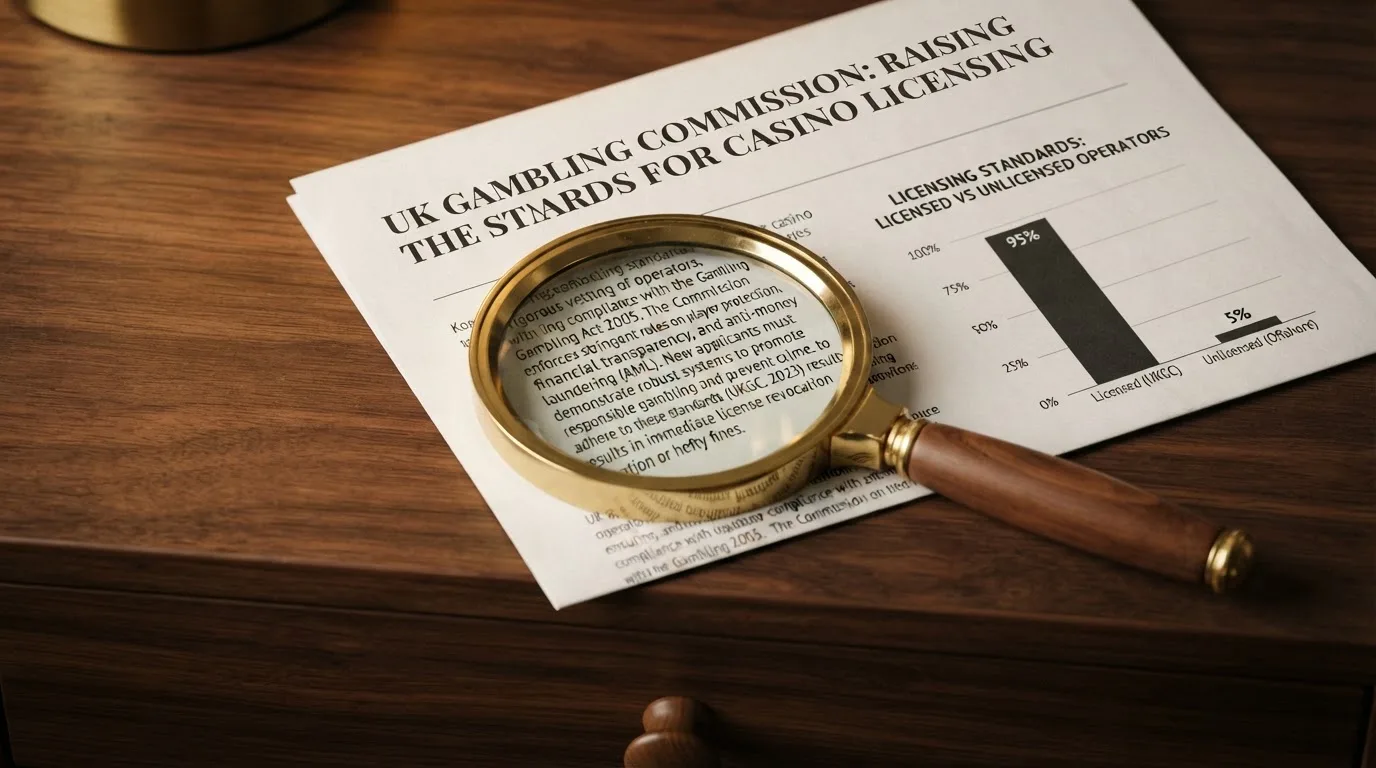
The minimum stake and the licence are independent dials. The £10 entry point is a commercial setting the operator chooses — it can be £1, £5, £10, £20 or anything above; many sites run several tiers. The licence is statutory, and it applies to the operator regardless of where the dial sits. A site that takes £1 deposits from a UK player without a Commission licence is committing the same offence under section 33 of the Gambling Act 2005 as one taking £1,000.
That independence is what makes the £10 figure a marketing anchor rather than a legal threshold. A “£10 minimum deposit casino” does not mean a smaller, more lightly regulated product; it means the same licensed product with a particular setting on its cashier. The Gambling Commission’s public register of gambling businesses is the verification mechanism for that claim, and the register is the only place where it can be checked. The Commission can and does remove or suspend licences, and the register updates within days of a change. A site that quotes a licence number which the register does not back is, by definition, not what it claims to be — even if its £10 minimum is real, even if its offer reads well, and even if a search engine has placed it at the top of the page.
The minimum deposit figure is also not a guarantee that the customer will be allowed to play at all. The Commission’s identity-verification rules require the operator to confirm the customer’s name, address and date of birth before accepting the first deposit or any play, and a customer who fails those checks cannot deposit. The £10 deposit only lands after the operator has satisfied itself on identity, age (18 or over) and the absence of a GAMSTOP self-exclusion match. For most readers that sequence is invisible; for a reader who is new to a particular operator it can add a working day to the first deposit, which is the practical price of the regulated product.
How the Gambling Commission’s register reads
The register is published as a CSV and Excel download on the Commission’s website, is searchable online, and updates as licences and domains change. Each licence holder has an account number, and each licence number takes the form account-R-number-suffix, where the leading six digits repeat the account number and the R marks a remote (online) licence. Status flags on the licence itself — Active, Surrendered, Revoked, Lapsed — and status flags on the domain — Active, Inactive, White Label — sit alongside. A white-label site trades under another company’s licence; Active and Inactive describe the domain entry, not the licence status.
As of 18 September 2026 the register listed 139 businesses holding an active remote casino operating licence, with 1,065 active and 361 white-label domain entries against them. Both figures move week to week as new licences are issued and old ones are surrendered or revoked, but the order of magnitude is the working picture of the licensed field: roughly 140 operators running several thousand UK-facing domains between them. The ten operators reviewed later in this article are a small sample of that licensed set, not a leaderboard of it; a register search will surface others the article does not name, and the reader who cares about breadth should run the search rather than rely on the sample.
The register also records who actually owns the licence. A handful of large gambling groups run multiple UK-facing brands from one account — LC International Limited, for instance, holds the licence behind Coral and runs Ladbrokes and Gala Bingo on the same account — and a casual reader who treats each brand as an independent operator is reading the market wrong. The licence holder, not the brand name, is the regulated entity; the brand is a marketing wrapper the holder operates.
Safer-Play Conditions at a £10 Deposit Threshold
The responsible-gambling frame at a UK-licensed casino is not an extra bolted onto the product. It is built into the licence. GAMSTOP participation is a mandatory licence condition for every online operator since 31 March 2020; deposit and time-limit prompts must precede a first deposit under rules that took effect in stages through 2025; affordability and financial-vulnerability checks run on a defined cadence against public data. None of these kick in because the player asked for them. They run because the licence requires them, and a player who finds them intrusive is reading the wrong end of the deal: the same rules are the reason the regulated product accepts UK customers at all.
The £10 deposit sits at the point where most of these conditions have already been met. By the time the cashier accepts the £10, the customer has been age and identity verified, the GAMSTOP database has been consulted, and the operator’s safer-gambling system has walked them through a financial-limit prompt. What changes at the £10 figure is not whether the conditions apply but how often they re-trigger — and that, more than anything else, is what a smaller-stake player should know.
GAMSTOP and the £10 entry point
GAMSTOP is the UK’s national online self-exclusion scheme, run by the not-for-profit GAMSTOP company and funded by the licensed operators themselves. A self-exclusion lasts six months, one year or five years and cannot be lifted early. When a player registers with GAMSTOP, every online operator licensed in Great Britain is required to refuse their deposits and to close their account, regardless of what minimum deposit that operator advertises. The £10 minimum does not buy a way past this; a self-excluded player cannot deposit £1 or £1,000 at any UK-licensed site while the exclusion is in force.
Casinos that market themselves as a route around this — branded or worded as a way to “no GAMSTOP” play — are doing one of two things. They are licensed in another jurisdiction (typically Curaçao or another offshore regime) and accept UK customers without the protection that licence would carry, or they are mis-stating the GAMSTOP relationship. Either way, a player registering with GAMSTOP and then trying to play at one of them is, by the Commission’s own statement, defeating the exclusion they themselves set. A £10 deposit at such a site also leaves the player without the Commission’s complaints route, without access to approved alternative dispute resolution, and outside the safer-gambling protections that licensed operators are required to provide. The headline price of “no GAMSTOP” is the loss of every protection the Commission enforces.
The licensed-frame alternative is straightforward: a player who self-excludes through GAMSTOP cannot deposit at any of the operators reviewed in this article, including at the £10 entry. A player who has not self-excluded can deposit £10 — and will be asked again, at intervals, whether they want to set a limit on future deposits.
Financial limits, reality checks and the affordability check
Three operator-side checks apply at or near the £10 deposit. First, before the first deposit, the operator must walk the customer through a financial-limit prompt — an opportunity to set deposit, loss or session-time limits that apply across the account. This is not a soft suggestion; the operator is required to make the prompt and to record the customer’s response, including a decision to set no limit. Second, a reality check runs at intervals during play (typically every 30 or 60 minutes), pausing the session to show net position and time spent. Third, financial-vulnerability checks run from £150 of net deposits in a rolling 30-day window — a threshold in force from 28 February 2025 — using public-data sources only; deeper financial risk assessments have been announced but were not yet in force at the snapshot date.
The affordability threshold matters disproportionately to the £10-deposit player because it fires on cumulative activity, not on the size of any single deposit. A player depositing £10 a week hits the £150 net-deposit trigger after fifteen weeks and again every cycle after that, regardless of the deposit size. A player depositing £100 twice hits it on the second deposit. The check is not punitive — its purpose is to surface customers whose gambling activity is consistent with harm — but it does require the customer to hand over information that an offshore site would not ask for, and to wait while the operator processes the check before further deposits are accepted. The trade-off is genuine: the licensed site asks, and the offshore site does not, and “does not ask” is precisely the selling point that an unlicensed site cannot survive without asking.
Settlement Routes: How a £10 Deposit and Payouts Move in the UK
A £10 deposit travels through the same payment rails as any other stake, and the rails are what decide how long the money takes to arrive, what currencies it can be held in, and how quickly any winnings come back out. Three broad routes carry most UK casino deposits: debit cards, bank transfer via the Faster Payments Service, and e-wallets. Credit cards are not available — the Commission banned credit-card gambling from 14 April 2020, including credit cards routed through e-wallets — and that ban is the only constant across the licensed field.
The Faster Payments Service, run by Pay.UK since 2008, is the rail that defines what “instant” means in a UK context. It operates around the clock, most payments arrive within minutes, and the scheme’s per-transaction limit is £1,000,000 — though individual banks set their own customer limits below this. Apple Pay, AstroPay and similar wallet products sit on top of these rails rather than beside them: a £10 Apple Pay deposit clears through a tokenised card that the issuing bank authorises in the usual way; an AstroPay deposit moves through the company’s electronic-money infrastructure. None of them change the underlying settlement story, only the wrapper the player sees at the cashier.
Card, bank transfer and e-wallet paths at £10
Card payments — debit cards, including Apple Pay transactions tokenised against a debit card — are the default at most UK-licensed casinos and the path most players arrive by. The £10 deposit clears against the card’s issuing bank through the standard authorisation flow; the funds appear in the casino balance within seconds. The same flow applies on the way out for withdrawals, less any operator processing delay; in practice, debit-card withdrawals at a UK-licensed site typically reach the customer’s account within one to three working days after the operator releases the funds, with the operator’s own internal processing window often the longest part of that.
Bank transfer via Faster Payments is the second route and the one most useful for the £10-deposit player. There is no minimum-bank-incompatibility concern at £10: Faster Payments has no scheme minimum, and £10 sits comfortably below the £1,000,000 ceiling. Bank transfer is also the route that best supports the receiving end of a withdrawal: the funds arrive in minutes once the operator releases them, which is material for any player who would rather not wait two working days for a card refund to clear.
E-wallets — PayPal where the operator accepts it, AstroPay’s UK-licensed electronic-money institution Larstal Limited, Neteller, Skrill — are the third route. The mechanics are similar to a card payment, but the wallet acts as a buffer: deposits clear from the wallet to the casino in near real time, and withdrawals back to the wallet typically arrive faster than to a debit card. AstroPay’s UK entity, Larstal Limited, holds FCA authorisation under the Electronic Money Regulations 2011, and the company’s broader group operates under separate licences in the Isle of Man, Brazil and Denmark. That licence stack matters for one reason: the customer funds are held as e-money under a regulated regime, and the recourse if something goes wrong runs through the FCA rather than through the casino. For a player who treats the e-wallet as their gambling bankroll, that buffer is the actual product — not the speed.
The Faster Payments ceiling and why it matters here
The Faster Payments limit shapes three things on a £10 deposit. It guarantees the deposit will clear (no scheme-side rejection for size); it bounds the maximum withdrawal that can move instantly through bank transfer at £1,000,000 per transaction, which is well above any plausible casino win; and it sets the practical upper limit on how fast an operator can pay out, because the operator’s release time, not the rail’s processing time, is the bottleneck. An operator that releases a withdrawal within hours will typically see the customer’s bank account credited in minutes once Faster Payments picks the instruction up. An operator that holds withdrawals for 24 hours, 48 hours or longer will see the customer wait that long regardless of which rail is used.
Two operational points follow. First, the £10 player who is moving their first withdrawal from a UK-licensed casino for the first time should expect an initial identity-check hold — a deposit has already cleared, but the first withdrawal typically triggers a fresh KYC review that can add a working day. This is an operator-side delay, not a rail-side delay, and it applies whatever the size of the withdrawal. Second, operators are not allowed to charge deposit or withdrawal fees on the licensed field for UK-licensed rails; what the player loses is time, not money, and the relevant question at any cashier is how many hours the operator will hold the funds before they reach the rail. The rail is the rail.
Ten UK-Licensed Casinos That Take a £10 Minimum Deposit
Ten operators from the Gambling Commission’s public register, each with a £10 minimum deposit available at their cashier, are reviewed below. The ranking is editorial; the licence and register entries are not. Every operator on this list holds a Commission remote casino operating licence with Active status as of 18 September 2026; every domain named is listed on the register against the licence holder, also Active. None of the cards is a recommendation to deposit; the reader who reaches this list has already made the choice to play at a licensed site, and the question here is which licensed site.
The licensed field at a glance
| Operator | Licence holder and GB remote casino licence | Domain status | Product focus |
|---|---|---|---|
| PokerStars | Stars Interactive Limited · 039108-R-319334-026 | Active | Casino + poker |
| Betfred | Petfre (Gibraltar) Limited · 039544-R-319290-010 | Active | Multi-product |
| Betfair | PPB Games Limited · 039411-R-319335-010 | Active | Multi-product |
| bet365 | Hillside (UK Gaming) ENC · 055149-R-331499-004 | Active | Multi-product |
| Unibet | Platinum Gaming Limited · 045322-R-324275-019 | Active | Multi-product |
| Coral | LC International Limited · 054743-R-330863-014 | Active | Multi-product |
| Casumo | Recro Limited · 061549-R-336718-002 | Active | Casino-only |
| 888casino | 888 UK Limited · 039028-R-319297-014 | Active | Casino-only |
| kwiff | Eaton Gate Gaming Limited · 044448-R-323408-017 | Active | Casino + mechanic |
| Midnite | Dribble Media Limited · 042647-R-321653-022 | Active | Casino + esports |
The table shows the licence number, the holder and the domain status at the snapshot date; the product-focus column is the article’s own cut. The reader who has narrowed the choice to “any licensed operator” has already cleared the most important filter, and the differences between these ten sit in product, payment-method coverage and offer shape rather than in the licence. What follows is one block per operator, each ending with a verdict on what the brand is for.
How each operator’s licence sits on the register
PokerStars. Stars Interactive Limited (account 39108) holds the active remote casino operating licence 039108-R-319334-026; PokerStars is listed as an active domain against that account. The Stars group has run a UK-facing poker product for two decades, and the casino tab sits beside it rather than replacing it. For a player who already plays poker on the platform, the casino offers continuity of wallet, loyalty programme and verification record; for a player who does not, the casino is one tab among many, with no particular £10 advantage. Verdict: the £10 deposit here suits the returning poker player who also wants to play slots, more than the slots-only newcomer.
Betfred. Petfre (Gibraltar) Limited (account 39544) is the licence holder behind Betfred’s active domain entry, with the active remote casino operating licence 039544-R-319290-010. The Betfred name sits on a large UK high-street bookmaking operation, and the online casino inherits the breadth of that footprint — extensive slot catalogue, full coverage of debit-card and bank-transfer rails, and an in-house safer-gambling operation. The £10 minimum matches the licensed-field standard. Verdict: the safer pick for a £10-deposit player who wants the high-street brand and consistency over novelty.
Betfair. PPB Games Limited holds licence 039411-R-319335-010, with Betfair listed against account 39411 as an active domain. The product has its roots in the betting exchange, and the casino sits adjacent to that core. For a £10-deposit slots player, the exchange heritage is irrelevant; the casino product is conventional. Verdict: the £10 deposit at Betfair makes sense where the player is already using the exchange and the casino is a secondary product.
bet365. Licensee Hillside (UK Gaming) ENC holds the active remote casino operating licence 055149-R-331499-004, with bet365 listed against account 55149. The largest single operator in the licensed field by player volume, and the most product breadth — sports, casino, poker, bingo, all on one wallet. A £10 deposit at bet365 gets the player the same wallet, the same loyalty treatment and the same payout processing the operator runs for the rest of its book. Verdict: the right £10 entry for a player who values product breadth and a single operator wallet over a casino-only experience.
Unibet (unibet.co.uk). Platinum Gaming Limited (account 45322) holds licence 045322-R-324275-019, with unibet.co.uk listed as an active domain on that licence. Unibet’s casino has a longer European history than its UK one and reflects that breadth in its catalogue. The £10 minimum is on the cashier. Verdict: the £10 deposit at Unibet is for a player who wants a European-flavoured casino catalogue inside the UK licence frame.
Coral (coral.co.uk). LC International Limited’s account 54743 carries licence 054743-R-330863-014, with coral.co.uk listed as an active domain against the same account. LC International also runs Ladbrokes and Gala Bingo from the same account, and the three brands share infrastructure — wallet, safer-gambling system, payment processing. A £10 deposit at any of the three looks the same on the back end. Verdict: Coral is for the £10-deposit player who knows the high-street brand and wants the same operational backbone, with no expectation of a casino-specialist product.
Casumo. Recro Limited (account 61549) holds the active remote casino operating licence 061549-R-336718-002; Casumo is the listed active domain. Casumo is a casino-only operator and built its product around that focus. The £10 deposit is on the cashier. Verdict: the £10 deposit at Casumo suits the player who wants a casino-only product and a loyalty programme that pays attention to casino play specifically.
888casino. 888 UK Limited holds licence 039028-R-319297-014, with 888casino listed as an active domain against account 39028. 888 is one of the longer-established casino-only brands in the licensed field. The £10 deposit matches the standard minimum. Verdict: the £10 deposit at 888casino suits a player who values a casino-only brand with a long UK licence history over a multi-product operator.
kwiff. Eaton Gate Gaming Limited’s account 44448 carries licence 044448-R-323408-017, with kwiff as the listed active domain. Kwiff entered the UK market more recently than most of the field and built its identity around a “surprise” mechanic on stakes rather than a conventional loyalty programme. The £10 deposit is on the cashier. Verdict: the £10 deposit at kwiff fits a player who wants a casino product with a different mechanic on offer from the established multi-product operators.
Midnite. Dribble Media Limited (account 42647) holds licence 042647-R-321653-022, with Midnite listed as an active domain. Midnite is the newest operator in this list and has built a casino product alongside an esports book. The £10 deposit sits on the cashier. Verdict: the £10 deposit at Midnite fits a player who wants a casino product from a newer UK-licensed operator and is comfortable with a smaller catalogue.
How the 10x Wagering Cap Reshapes a £10-Deposit Bonus
From 19 December 2025 the Commission banned any wagering requirement higher than 10x the qualifying amount on bonuses at UK-licensed operators. Mixed-product offers — the marketing pattern where a sports bet comes with attached casino spins, or a slots deposit unlocks a free bingo ticket — are banned as well. The cap applies to the bonus as offered; the headline “welcome bonus” cannot be dressed up by a 35x or 40x playthrough hidden in the small print.
The effect of the cap is most visible when the page translates it into turnover. Take a representative bonus figure of £100 in bonus funds. Under the 10x cap, the player must wager £1,000 in qualifying bets before withdrawing any bonus-derived winnings — the formula is bonus × 10. Scale the same formula across the band of typical welcome offers and the required turnover now runs from £100 (a £10 bonus) to £2,000 (a £200 bonus), at every UK-licensed casino in the field. There is no licensed operator above 10x; any number higher than that on a UK-facing page is either pre-cap marketing, an offshore offer, or an error. The same point stated in reverse: a £10 bonus now costs £100 of play to clear, where under a 40x model that figure would have been £400.
The wagering-cap arithmetic is an estimate over many spins, not a guarantee for any single session. The reader who deposits £10 and never claims a bonus pays no turnover requirement; the reader who claims a £100 bonus should expect to put £1,000 of wagering through the operator before the bonus balance converts, with the operator’s own contribution rules (which slots qualify, what percentage of stake counts) defining what that £1,000 looks like in practice. The 10x cap makes the cost legible; it does not eliminate it. A “free” £100 bonus is never free, and the cap stops the marketing at ten times the bonus rather than at zero.
Two practical caveats sit beside the formula. First, the cap covers wagering requirements; it does not cover other terms a bonus can carry — max-cashout caps on free-spin winnings, restricted games, time limits on completing the wagering. A bonus with a low turnover requirement can still carry an unattractive max-cashout figure, and the reader who reads only the wagering line is reading half the contract. Second, the cap attaches to the bonus as a separate item; deposit-only promos without bonus funds are not affected, and the £10-deposit player who simply wants to play with their own money rather than with bonus money avoids the question entirely.
Fundamentals of £10-Deposit Play Across the UK Licensed Market
The £10 entry sits in the middle of the British online casino deposit range. Below it sits a £5 tier that several operators run for marketing reasons, and a £1 or £2 tier that some brands advertise on the front page and then walk back to £10 on the cashier when the deposit is attempted. Above it sit £20 and £25 tiers, often tied to welcome-bonus eligibility, and the £50–£100 tier that high-roller products assume. The £10 figure is not a regulatory threshold, not a payment-method minimum, and not a bonus-eligibility floor in most cases — it is a commercial anchor where most of the licensed field sits.

Where the £10 stake sits on the curve
Three practical effects follow. First, the £10 player gets the full set of safer-gambling protections from the first deposit; nothing about the size of the stake reduces the GAMSTOP check, the affordability check or the reality-check intervals. Second, the £10 player gets the full set of payment-method options — there is no rail that requires a larger stake and no rail that refuses the £10 figure. Third, the £10 player is exposed to every offer term a higher-stake player would see, including the wagering requirement and the max-cashout clauses that go with it. The smaller stake does not buy smaller terms; the terms are written for the bonus, not for the player.
The choice between £10 and a higher entry is, then, mostly a choice about offer eligibility. Some welcome bonuses attach to a minimum first deposit above £10 — typically £20 or £25 — and the £10-deposit player who wants the bonus must meet that threshold or pick a different offer. The £10 player who is happy to skip the welcome bonus pays no opportunity cost on that score, but does lose access to anything the bonus would have funded (free spins, bonus cash, tournament entries). The choice is real, but it is a choice about marketing rather than about product.
Reading the offer against the registered operator
The register of 139 active remote casino operating licences at the snapshot date is the test of whether a brand claiming a £10 minimum is, in fact, licensed. The search by domain name returns the licence holder and the licence number; the search by licence holder returns every domain running on that licence. The figure the marketing emphasises — £10 minimum, 100% bonus, “free spins on Book of Dead” — is independent of the licence status, and the two should be read separately. A licensed operator with a poor offer is still a licensed operator, and an unlicensed operator with a generous offer is still an unlicensed operator.
For the player who has already decided to play at a UK-licensed site, the comparison narrows to product: which catalogue, which payment coverage, which loyalty programme, which bonus shape. The ten operators reviewed above split, roughly, into three groups by that test. The multi-product operators (bet365, Betfair, Coral, Unibet, Betfred) offer breadth — sports, casino, sometimes poker and bingo — under one wallet. The casino-only operators (Casumo, 888casino, kwiff, Midnite, and the casino tab of PokerStars) focus the loyalty programme and the product on casino play. Within each group, the differences are catalogue and product rather than licence and regulation, and the choice is a matter of taste.
The licensed frame is the floor. Everything above it — the catalogue, the welcome offer, the loyalty scheme, the payment-method coverage — is the part the £10-deposit player actually gets to choose between. The choice matters, but it does not change the floor, and a reader who finds themselves comparing offers across the ten operators reviewed above has already done the work that determines whether the rest of the comparison is worth running at all.
Frequently Asked Questions
What counts as a £10 minimum deposit at a licensed UK casino?
The £10 figure is the cashier’s smallest single-transaction deposit, not the smallest balance needed to play. It applies to first and subsequent top-ups at the same threshold, and sits in a £5–£25 range common across the licensed UK field. Payment-method floors (where a card or e-wallet has its own minimum) sit on top of the casino’s setting, so the practical minimum is whichever is higher.
Is a £10 minimum deposit casino safe to use?
Depends on whether it holds a Gambling Commission remote casino operating licence. A licensed operator at £10 is regulated to the same standard as a licensed operator at any other minimum — GAMSTOP, age verification, affordability checks, ADR access. An unlicensed site at £10 carries none of those protections, regardless of how the offer looks at the cashier.
Can I find a £10 minimum deposit casino that is not on GAMSTOP?
A site marketed as “not on GAMSTOP” and taking UK customers is operating outside the UK licence. It will not appear on the Commission’s register, and the protections the register enforces do not apply. The player choosing such a site is forfeiting Commission protection in exchange for the absence of the check.
How quickly do withdrawals settle after a £10 deposit?
Settlement timing does not depend on the deposit size. A withdrawal approved by the operator will reach a UK bank account within minutes via Faster Payments, within one to three working days to a debit card, or near-instantly to a regulated e-wallet. The bottleneck is the operator’s release time — typically hours to 48 hours — not the rail itself.
Which payment methods accept a £10 minimum deposit?
UK-licensed casinos typically accept debit cards (including Apple Pay tokenised against a debit card), bank transfer via Faster Payments, and one or more e-wallets (PayPal where available, AstroPay via Larstal Limited, Neteller, Skrill). Credit cards are banned for gambling and not an option.
Created by the ”signupbonuscheck” editorial team.