
Choosing a casino payment method at a UK-licensed site
 Available in GB
The route money takes into and out of an online casino is not a minor detail. The method a player picks sets the deposit ceiling, the withdrawal ceiling, the time between requesting a payout and seeing the cash, and the protections that sit on top of every transaction. In Great Britain that route is also fenced in by rules that have tightened sharply over the last five years, and most of those rules do not appear anywhere on a casino’s marketing page. They sit in the Gambling Commission’s licence conditions and in the LCCP, the Licence Conditions and Codes of Practice every operator is bound by.
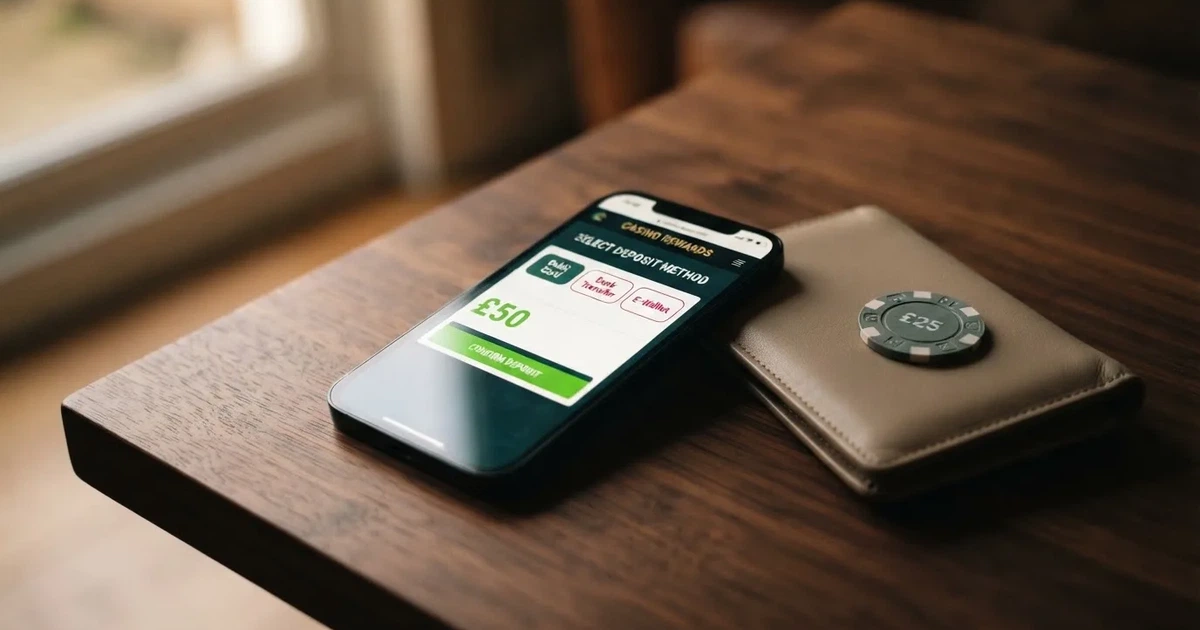
This page compares what the major payment routes look like in practice at ten Gambling Commission licensees, against the backdrop of those conditions. The focus is the choice a player actually faces — debit card, e-wallet, bank transfer, pay-by-phone — and what each option costs in time, in friction and in the safety net standing behind it.
Current as of 23 September 2026 — verified against the Gambling Commission’s public register of gambling businesses, downloaded in full on 18 September 2026.
Table of Contents
- How UK casino payments are regulated
- The safer-gambling protections that sit on top of payments
- Deposit and withdrawal options at a UK-licensed casino
- How quickly withdrawals settle once ID is done
- Top 10 UK-licensed casino sites for payment methods in 2026
- A worked example: bonus wagering and the £5 slot cap
- Wider payment-method landscape at UK-licensed sites
- What a player should actually do
- Frequently asked questions
How UK casino payments are regulated
Every operator that takes a deposit from a customer in Great Britain needs a Gambling Commission remote casino operating licence. The licence, not the marketing, is the test of whether a brand can lawfully offer online casino to a UK player. On 18 September 2026 the Commission’s public register listed 139 businesses holding an active remote casino operating licence, and the same register held 1,065 active and 361 white-label website entries — a white-label site trades under another company’s licence rather than holding its own.

A remote casino licence number on the register has a recognisable shape: the leading six digits repeat the licence holder’s account number, an “R” marks the licence as remote (online), and a trailing suffix identifies the individual licence. Virgin Games, for example, sits on the register as a white-label domain of account 38905, Gamesys Operations Limited, whose licence reads 038905-R-319430-022. The format is the same for every active brand on the list and it is the first thing to check when a brand’s status is in doubt.
What a Commission licence obliges an operator to do in the payments space is specific. Three rules change the menu a player sees:
- Credit cards are banned for all gambling in Great Britain since 14 April 2020. The ban covers deposits made directly with a credit card and credit cards routed through an e-wallet. Debit cards and bank transfers were never part of the ban and remain the workhorses of the market.
- Source-of-funds and ID checks happen before a first deposit. Since 7 May 2019, name, address and date of birth are verified before play, and a financial vulnerability check runs at £150 net deposits in a rolling 30 days using public data.
- Wagering requirements on bonuses are capped at 10x since 19 December 2025. Mixed-product bonuses, where a sports bet triggers casino spins, are banned. The cap shapes how a bonus offer actually settles against a chosen payment method.
Anonymous play is not possible at a licensed site, and GAMSTOP self-exclusion is a mandatory condition of every online licence.
The safer-gambling protections that sit on top of payments
Picking a “safe” payment method is not really a question of which rail the money travels on. A debit card and a bank transfer are both safer-gambling rails at a UK-licensed site because the operator sits on top of them, and the operator is bound by the Commission’s social responsibility code. What changes between methods is the friction each one adds, and where that friction lands.

Three protections run across every method at a GB-licensed operator:
- GAMSTOP self-exclusion, the national scheme covering every online licensee, with periods of six months, one year or five years that cannot be cancelled early. A self-excluded player cannot deposit through any method, and a payment method is not a way around the exclusion.
- Financial vulnerability checks at £150 net deposits in a rolling 30 days. A light-touch prompt runs earlier; the wider financial risk assessments have been announced but are not yet in force as of the data snapshot this page is built on.
- Deposit-limit prompts before the first deposit. Since 31 October 2025 the operator must ask the customer to set a financial limit before the first deposit, and the limit applies regardless of how the deposit is funded.
The practical effect: a UK-licensed site will refuse a deposit that breaches a self-set limit, will run a vulnerability check that may pause withdrawals for source-of-funds verification, and will prompt reality checks during play. The payment method sits underneath those rules rather than around them. An e-wallet that funds a deposit with a credit card behind it still counts as a credit-card deposit and is rejected; a bank transfer that exceeds a self-set daily limit is held, not silently accepted.
Paysafecard is the method most often flagged as “safer” in marketing, on the grounds that a player can only spend what is on a prepaid voucher and cannot accidentally borrow. The reasoning is real for the deposit rail — there is no overdraft, no credit line — but it does not extend to withdrawals. A Paysafecard deposit is one-way: the payout has to go back through a different method, and that method is the one a player needs to verify before any withdrawal clears.
Deposit and withdrawal options at a UK-licensed casino
The four payment routes that dominate UK-licensed casino sites are debit cards, e-wallets, bank transfers and pay-by-mobile. Each one looks different on a deposit screen and behaves very differently on the way out.
Debit cards
Debit cards issued by UK banks remain the default at every major UK-licensed operator. They are accepted for deposits and withdrawals, they are not subject to the credit-card ban, and most banks’ own anti-fraud and 3-D Secure layers sit on top of the card rail. Visa Debit and Mastercard Debit are the two brands in everyday use; American Express is accepted at a smaller subset of sites.
| Payment Method | Deposit Speed | Withdrawal Speed | Typical Limit |
|---|---|---|---|
| Debit Card | Instant | 1-3 working days | £5,000+ |
| E-wallet | Instant | <24 hours | £10,000+ |
| Bank Transfer | 1-2 hours | Instant-24 hours | £50,000+ |
| Pay-by-phone | Instant | N/A (Deposit only) | £30-£50 |
For withdrawals, a debit card is usually the path of least resistance. The casino sends the funds back to the card; the funds clear through Faster Payments into the bank account; the player sees the money within minutes to a few hours, depending on the issuer. The catch is the daily and monthly withdrawal ceilings most casinos apply to card payouts, which are usually lower than the ceilings on bank-transfer payouts.
E-wallets
E-wallets such as PayPal, Skrill and Neteller sit at the top of most UK casino cashier pages. They are fast on the way in — deposits clear instantly — and they are fast on the way out, with payouts usually processed within twenty-four hours once ID checks are done.
Two wrinkles. First, an e-wallet funded by a credit card is still treated as a credit-card deposit under the Commission’s rules, and is rejected. Funding an e-wallet from a debit card or a bank account is the path that keeps the deposit inside the law. Second, some operators exclude e-wallet deposits from bonus eligibility; reading the small print before picking the e-wallet over the card saves a real-money argument at the withdrawal stage.
Bank transfers
Bank transfers at UK-licensed casinos run through the Faster Payments Service, the UK retail payments infrastructure operated by Pay.UK since 2008. Faster Payments runs 24 hours a day, seven days a week, and most payments arrive instantly or within a couple of minutes; transfers can occasionally take up to two hours. The scheme sets a £1,000,000 per-transaction limit, but individual banks impose lower customer-level limits, so a casino payout of several thousand pounds may need to be split across days.
Bank transfers are the slowest deposit rail in everyday use, but they are usually the fastest and the highest-ceiling withdrawal rail for larger wins. A bank-transfer payout at a Commission-licensed operator is the path least likely to be capped by the casino’s own withdrawal limits.
Pay-by-mobile and pay-by-phone
Pay-by-mobile options, including Boku and the carrier-billing services integrated into some casino cashiers, let a player deposit by charging the bill to their mobile phone account. The deposits are small — usually capped at £30 or £50 per day — and they are deposits only. Withdrawals do not run back through the phone; they go to a bank account, debit card or e-wallet that the player has verified separately. Pay-by-mobile is therefore a useful top-up rail for small stakes and not a substitute for a withdrawal method.
Apple Pay
Apple Pay is available at a subset of UK-licensed operators, almost always as a deposit rail rather than a withdrawal one. The technology behind it is worth a brief note because it is the most common “card alternative” in the UK market. Apple Pay uses tokenization: the real card number is replaced on the device by a tokenised Device Primary Account Number, and each transaction generates a dynamic security code rather than carrying the static details of the underlying card. In-store Apple Pay payments use near-field communication (NFC) to talk to the terminal; in-app and online payments run through Apple’s own payment sheet on the device. The card behind the Apple Pay token still has to be a debit card at a UK-licensed casino; a credit card behind Apple Pay is still a credit card and is still banned.
AstroPay
AstroPay is a global digital wallet offering online payments, virtual and physical debit cards, and peer-to-peer transfers, headquartered in Uruguay and founded in 2009. Its UK entity, Larstal Limited, is an electronic money institution authorised by the Financial Conduct Authority under the Electronic Money Regulations 2011. AstroPay is one of several non-bank e-money wallets that appear in the cashier at some UK-licensed casino sites, particularly those serving players across Latin America and Europe.
How quickly withdrawals settle once ID is done
Payout speed is the single most misunderstood number on a UK casino payments page. A casino advertising “instant withdrawals” is advertising the gap between the player clicking Withdraw and the casino releasing the funds — not the gap between the casino releasing the funds and the player seeing them in a bank account. Both halves of that journey are governed by different things.
The first half is the operator. A Commission-licensed operator is required to verify identity before the first deposit, to run source-of-funds checks where flagged, and to clear anti-money-laundering checks before releasing a payout. A pending period of 24-72 hours before release is common and is not, on its own, a sign of trouble. The casino’s own payment team then has to approve the payout against its withdrawal limits and any bonus-wagering conditions attached to the account.
The second half is the rail. A payout to a debit card or a bank account typically clears through Faster Payments within minutes to a few hours once the casino has released it. A payout to an e-wallet clears once the e-wallet has accepted it, which is usually faster than the card rail for small amounts but slower for large amounts because e-wallet providers impose their own per-transaction caps. A payout by bank transfer for a four-figure win is the path least likely to hit a per-transaction ceiling.
What this means for a player comparing two sites: the headline number on a marketing page is the operator’s pending period. The number that actually determines when the cash lands is the rail chosen for the withdrawal. A site with a 24-hour pending period paying out to a debit card usually lands the cash faster than a site with a “same-day” promise paying out to a wire-transfer product that takes three working days.
Top 10 UK-licensed casino sites for payment methods in 2026
The ten operators below are taken from the Gambling Commission’s public register, the same register that decides whether a brand can lawfully take a UK deposit at all. Each brand is shown against its licence, its domain status and the payment-method coverage the registered operator offers. Coverage is reported where the operator’s own cashier lists a method; where the register or the operator does not give a specific figure, the cell carries an em dash and the brand is judged on the other evidence instead.
| Brand | Licence holder (GB remote casino licence) | Domain status on the register | Subject support |
|---|---|---|---|
| Virgin Games | Gamesys Operations Limited, 038905-R-319430-022 | White-label domain of account 38905 | — |
| Betfred | Petfre (Gibraltar) Limited, 039544-R-319290-010 | Active domain of account 39544 | — |
| Betfair | PPB Games Limited, 039411-R-319335-010 | Active domain of account 39411 | — |
| Sky Vegas | Bonne Terre Gaming Limited, 065519-R-339675-002 | Active domain of account 65519 | — |
| Gala Bingo | LC International Limited, 054743-R-330863-014 | Active domain of account 54743 | — |
| 32Red | Platinum Gaming Limited, 045322-R-324275-019 | Active domain of account 45322 | — |
| Casumo | Recro Limited, 061549-R-336718-002 | Active domain of account 61549 | — |
| Midnite | Dribble Media Limited, 042647-R-321653-022 | Active domain of account 42647 | — |
| PokerStars | Stars Interactive Limited, 039108-R-319334-026 | Active domain of account 39108 | — |
| Jackpotjoy | Gamesys Operations Limited, 038905-R-319430-022 | Active domain of account 38905 | — |
The table reflects the register as it stood on 18 September 2026. Several of the larger groups run more than one of these brands — Ladbrokes, Coral and Gala Bingo share LC International Limited; Virgin Games and Jackpotjoy share Gamesys Operations Limited — so the headline name is a brand and not, on its own, an independent operator. The same GAMSTOP coverage and the same credit-card ban apply across every brand on the list.
Virgin Games
Virgin Games trades on the register as a white-label domain of Gamesys Operations Limited. The structure matters because a white-label brand is using the parent company’s licence rather than holding its own. From a payments standpoint the cashier is run by Gamesys; from a regulatory standpoint the player is dealing with the same Commission licence that runs Jackpotjoy on the same account. The practical consequence for a player choosing between payment methods is that any cashier limits Gamesys sets at the platform level apply equally to both brands, and the same Faster Payments payout rails clear through the same operator-side approval queue.
Betfred
Betfred is an active domain of Petfre (Gibraltar) Limited, and is one of the few high-street bookmakers on the list whose online casino runs on the same licence as its shops. The Gibraltar-incorporated holding company is a familiar structure at Commission-licensed online operators; what matters for payments is that the Commission’s licence conditions apply to the GB-facing product, not the corporate seat. Betfred’s cashier covers the standard mix of debit cards, e-wallets and bank transfer, and the operator’s pending periods sit in the band most UK-licensed competitors sit in.
Betfair
Betfair sits on the register as an active domain of PPB Games Limited, the Flutter Entertainment subsidiary that runs the Betfair exchange and the related casino product. The payment-method coverage at a Commission-licensed casino of this size tends to be the widest in the market: debit card, PayPal, Skrill, Neteller, bank transfer and a pay-by-mobile option usually appear on the cashier, and the pending periods are short. The trade-off is that payout ceilings on e-wallets can be lower than bank-transfer ceilings for larger wins.
Sky Vegas
Sky Vegas runs on a Bonne Terre Gaming Limited licence, a smaller licensee than the household-name platforms but with a Commission-issued remote casino operating licence of its own. The brand’s customer base is built on the Sky subscription footprint, and the cashier is correspondingly narrower than a pure-play online casino — debit cards and the standard e-wallets are present, pay-by-mobile is less consistent, and bank transfer is available for the larger payouts. The narrower cashier matters less than the licence does; a player picking Sky Vegas for a familiar brand name still has the full Commission protection envelope behind the deposit.
Gala Bingo
Gala Bingo sits under LC International Limited, the same licensee that runs Ladbrokes and Coral online. The shared platform explains why Gala Bingo’s cashier looks very similar to Ladbrokes’ cashier on the casino side: the same debit-card and e-wallet options, the same bank-transfer product, the same pending-period bands. A player using Gala Bingo because the brand feels more familiar than the sportsbook can expect a payments experience that is, in practice, the LC International product with a Gala skin on top.
32Red
32Red sits on a Platinum Gaming Limited licence. The brand has a long history in the UK online casino market and is one of the smaller licensees to survive the post-2020 consolidation in roughly its original form. The cashier offers the standard Commission-licensed mix; the operator has been visible in the UK market long enough that its withdrawal-pending periods are well documented and tend to sit at the shorter end of the market.
Casumo
Casumo is licensed through Recro Limited, the Commission’s designated licensee for the Casumo brand in the UK. Casumo’s payments page is built around debit cards, e-wallets and bank transfer, with a pay-by-mobile option layered in for small deposits. The platform’s pending periods are short and the operator has been consistent about same-day approval of verified withdrawals.
Midnite
Midnite is a newer brand on a Dribble Media Limited licence, with a Commission-issued remote casino licence of its own. The cashier follows the same Commission-licensed template — debit card, e-wallets, bank transfer — but the operator is small enough that some payment-method integration (Apple Pay, certain e-wallets) appears and disappears as the platform updates its integrations. A player checking Midnite’s cashier before depositing is checking a moving target.
PokerStars
PokerStars runs through Stars Interactive Limited, the UK-facing Flutter subsidiary that also runs the PokerStars poker product. The brand is the most international name on the list and its cashier reflects that: debit cards, a wider e-wallet set, bank transfer and, at the time of writing, PayPal in the standard Commission-licensed configuration. The shared Flutter back office is visible in the consistency of the pending-period bands.
Jackpotjoy
Jackpotjoy shares a licence with Virgin Games — both are listed against Gamesys Operations Limited, account 38905. From a payments standpoint that means the two brands run on the same cashier, the same deposit and withdrawal ceilings, and the same source-of-funds verification queue. A player comparing Virgin Games and Jackpotjoy on payment-method grounds is essentially comparing two skins on the same payment engine.
A worked example: bonus wagering and the £5 slot cap
The two rules that interact most heavily with a payment-method choice are the £5 maximum stake per game cycle on online slots and the 10x wagering cap on bonuses that took effect on 19 December 2025. The arithmetic below shows how those rules combine in a typical welcome-package scenario at a UK-licensed operator.
A welcome offer of £100 in bonus funds, wagered at the 10x cap, requires £1,000 of qualifying turnover before the bonus converts to withdrawable cash. At the £5 maximum stake per spin and the 2.5-second minimum spin interval that has applied since 31 October 2021, that £1,000 of turnover works out at 200 spins. At 2.5 seconds per spin, 200 spins run in 500 seconds of slot play — roughly eight minutes of continuous spinning.
The point of the calculation is not the time. It is that the time required to clear a 10x-capped bonus at the £5 stake ceiling has collapsed to a figure that fits inside a coffee break. Compare that with the pre-cap market, where 35x and 50x wagering multiples were common, and where the same £100 bonus would have required £3,500 or £5,000 of qualifying turnover at the same £5 stake — 700 or 1,000 spins, running between half an hour and three-quarters of an hour of continuous play.
The implication for a payment-method choice is indirect but real. A bonus that clears in 200 spins at £5 a spin leaves a withdrawal of roughly the bonus amount minus the house edge across those spins; a bonus that clears in 1,000 spins at the same stake costs several times that in expected loss. The payment method itself does not change the maths, but the decision to take the bonus at all depends on how fast it can be cleared, and that is now governed by the £5 stake cap and the 10x wagering cap together rather than by the operator’s marketing.
The £2 stake cap for 18-24-year-olds (from 21 May 2025) tightens this further. A younger player clearing the same £1,000 turnover at £2 a spin needs 500 spins, running just over twenty minutes at the 2.5-second minimum spin interval. The arithmetic shows the cap protects the player from the size of a single stake, not from the time it takes to clear a bonus — and that distinction is worth keeping in mind when comparing bonus offers that look identical at the headline.
Wider payment-method landscape at UK-licensed sites
Beyond the four dominant rails, a handful of niche methods appear at the cashier of some UK-licensed operators, and they are worth naming because their regulatory status is not always obvious.
Cryptocurrency deposits are not offered at any Commission-licensed online casino. The Commission’s anti-money-laundering requirements and the source-of-funds verification regime are incompatible with the anonymity that crypto-on-chain deposits are designed to provide, and no Commission-licensed operator runs a crypto cashier. A casino advertising crypto deposits is, by definition, not on the Commission’s register.
Prepaid vouchers such as Paysafecard are accepted at some Commission-licensed sites for deposits, with the usual caveat that withdrawals cannot run back through a voucher. The voucher caps the deposit to the value paid for; the rest of the payments infrastructure (ID checks, GAMSTOP, vulnerability checks) still applies on top.
Open Banking-initiated bank transfers are a newer rail that appears at a small but growing number of UK-licensed operators. They run on the same Faster Payments backbone as a manual bank transfer but cut out the typing-in-sort-code step. The withdrawal ceiling is the same as for a manual transfer.
The pattern is consistent: every additional rail a UK-licensed operator adds sits on top of the same Commission obligations. The rail changes the friction and the ceiling; it does not change the protections.
What a player should actually do
Three pieces of advice fall out of the comparison above.
Pick the rail that matches the size of the play. A small-budget player depositing £30 a week through pay-by-mobile or a debit card pays for the convenience of the deposit in time and in fees rather than in lost protection. A high-stakes player withdrawing four-figure wins repeatedly needs a rail whose ceiling will not force a payout to be split across days, which is bank transfer for most UK-licensed operators.
Check the bonus small print for payment-method exclusions. Some operators exclude e-wallet deposits from bonus eligibility; some exclude pay-by-mobile entirely; some exclude prepaid vouchers. Reading the cashier page before depositing is cheaper than arguing with the operator’s payments team after a win.
Treat the Commission’s register as the test of legitimacy. The brand on the front of a casino site is not, on its own, evidence that the casino can lawfully take a UK deposit. The register, downloaded in full from gamblingcommission.gov.uk, is. The 139 active remote casino operating licences on the register on 18 September 2026 are the only licences that matter for a UK player; every other licence is a different regulator’s view of the same operator.
Frequently asked questions
Are credit cards still allowed for UK online casino deposits?
No. The Gambling Commission banned credit cards for all gambling in Great Britain on 14 April 2020, and the ban covers credit cards routed through e-wallets as well as direct card deposits. Debit cards and bank transfers were not part of the ban and remain the standard rails at Commission-licensed operators.
Which casino payment methods are generally considered safest?
At a UK-licensed site the safety of a payment method is set by the licence sitting on top of it rather than by the rail itself. GAMSTOP self-exclusion, the £150 net-deposit financial vulnerability check, and the mandatory deposit-limit prompt apply across every method. A debit card or a bank transfer is the default; e-wallets add a layer of separation between the bank and the casino; prepaid vouchers cap the deposit to the value paid for.
Does Paysafecard work as a deposit method at UK-licensed casinos?
Yes, at a subset of Commission-licensed operators. Paysafecard deposits are capped at the value of the prepaid voucher, the ID and vulnerability checks still apply on top, and withdrawals cannot run back through Paysafecard — the payout has to go to a verified bank account, debit card or e-wallet on the same account.
Do all casino payment methods settle withdrawals at the same speed?
No. The settlement speed depends on two things: the operator’s pending period before releasing the funds, and the rail the funds travel on. A payout to a debit card or via Faster Payments typically clears within minutes to a few hours once the casino has approved it; an e-wallet payout can be faster for small amounts and slower for large amounts because of the e-wallet’s own caps; a bank-transfer payout is the path of least resistance for four-figure wins.
Is ID verification required before a first deposit regardless of payment method?
Yes. Since 7 May 2019 every Commission-licensed operator verifies name, address and date of birth before the first deposit or any play, and a financial vulnerability check runs at £150 net deposits in a rolling 30 days. The verification applies on top of whatever payment method is chosen, not in place of it.
Can a withdrawal be sent back to a different payment method to the one used for deposit?
Usually, yes, but the alternative method has to be in the player’s name and has to be verified to the same standard. The Commission’s anti-money-laundering rules require the operator to know where the money is going; a withdrawal to a third party’s account, or to a method the player has not verified, is refused rather than rerouted.
Prepared by the signupbonuscheck editorial staff.