
Online casino with 300% bonus in the UK — what the offer actually buys
A 300% casino bonus in the UK: how the offer stacks up, what it costs to clear, and which sites can legally pay it
The marketing line is short. A 300% welcome bonus quadruples the first deposit — £20 in, £80 of playable funds, £60 of which came from the house. The mechanics behind that line are longer, and they decide whether the offer is worth claiming. Under current UK rules the wagering ceiling sits at ten times the bonus, the credit-card tap is closed, and any site taking British customers must hold a Gambling Commission licence and screen every player against GAMSTOP before the first spin. This page walks through what a 300% match really gives a player, what it takes to clear it, and which of the ten brands on the Commission’s public register actually run a casino a British customer can reach.

Data current as of 8 November 2026 and checked against the Gambling Commission’s public register of gambling businesses.
Table of Contents
- What a 300% match bonus actually pays out
- The licence every British-facing site must hold
- What GAMSTOP and identity verification mean for the offer
- Paying in and paying out: the rails that work for a 300% bonus
- The wagering cap in force since 19 December 2025
- Time limits, game weighting, and the small print that ends the bonus
- The featured brands and how they sit on the register
- Comparing the brands across the licence fields
- Who the offer actually suits
- What to do before claiming
- The offshore alternative and what it costs
- The signals that a brand is unlicensed
- How the 10x wagering cap closes a market
- The case for reading the licence number, not the headline
- The bottom line on the offer
- Frequently asked questions
What a 300% match bonus actually pays out
A 300% bonus adds three times the deposit to the playable balance on top of the deposit itself. A £20 deposit produces a £20 cash balance plus a £60 bonus balance — £80 in total, which the marketing copy calls “£20 turned into £80”. The cash and the bonus are not the same thing. Cash can be withdrawn at any point, subject to the deposit having been used once. Bonus funds cannot be withdrawn at all until their wagering requirement is met, and the wagering requirement sits on the bonus amount, not on the deposit.

That distinction is the first thing to grasp, because every later clause — the time limit, the game weighting, the maximum stake per spin — protects it. The house gives you extra money to play with, on the condition you play with it a certain number of times first. If you walk away having used only your £20 cash, the £60 sits locked in the bonus balance until the wagering is complete or expires.
The second thing to grasp is the cap. A 300% bonus always comes with a maximum bonus figure — the headline stops scaling past a certain deposit. £100 is a common ceiling: a £33 deposit brings the full 300%, a £100 deposit still brings only £300 of bonus because the cap kicks in, and a £500 deposit still brings only £300 of bonus. Above the cap, the percentage is meaningless. The cap, not the percentage, is the real size of the offer.
The third thing is the wagering requirement. A bonus with a 30x requirement means the player has to stake thirty times the bonus amount before it converts to withdrawable cash. Under UK rules in force since 19 December 2025 the wagering requirement on any casino bonus is capped at 10x. Any “300% bonus, 30x wagering” headline has to be read as either offshore and unlicensed, or as a promotion structured around free spins rather than a deposit match — see the section on the wagering cap for how that line is drawn.
A final framing point. The 300% match is a welcome offer, not a reload. It runs once, on the first deposit, and the licence holder usually attaches a minimum deposit below which the bonus does not trigger at all. The minimum and the cap define the useful deposit range — pay less and nothing happens, pay more and the excess deposit is yours but the bonus does not scale.
The licence every British-facing site must hold
Any operator taking customers in Great Britain — England, Scotland and Wales — needs a Gambling Commission remote casino operating licence. The relevant law is the Gambling Act 2005, tightened for remote gambling by the Gambling (Licensing and Advertising) Act 2014, which removed the previous arrangement under which an operator based overseas could serve British customers on its home regulator’s authority. A Curaçao, Maltese or Gibraltar licence is not a substitute for the Commission licence; a brand without one is, in the Commission’s view, an illegal site.
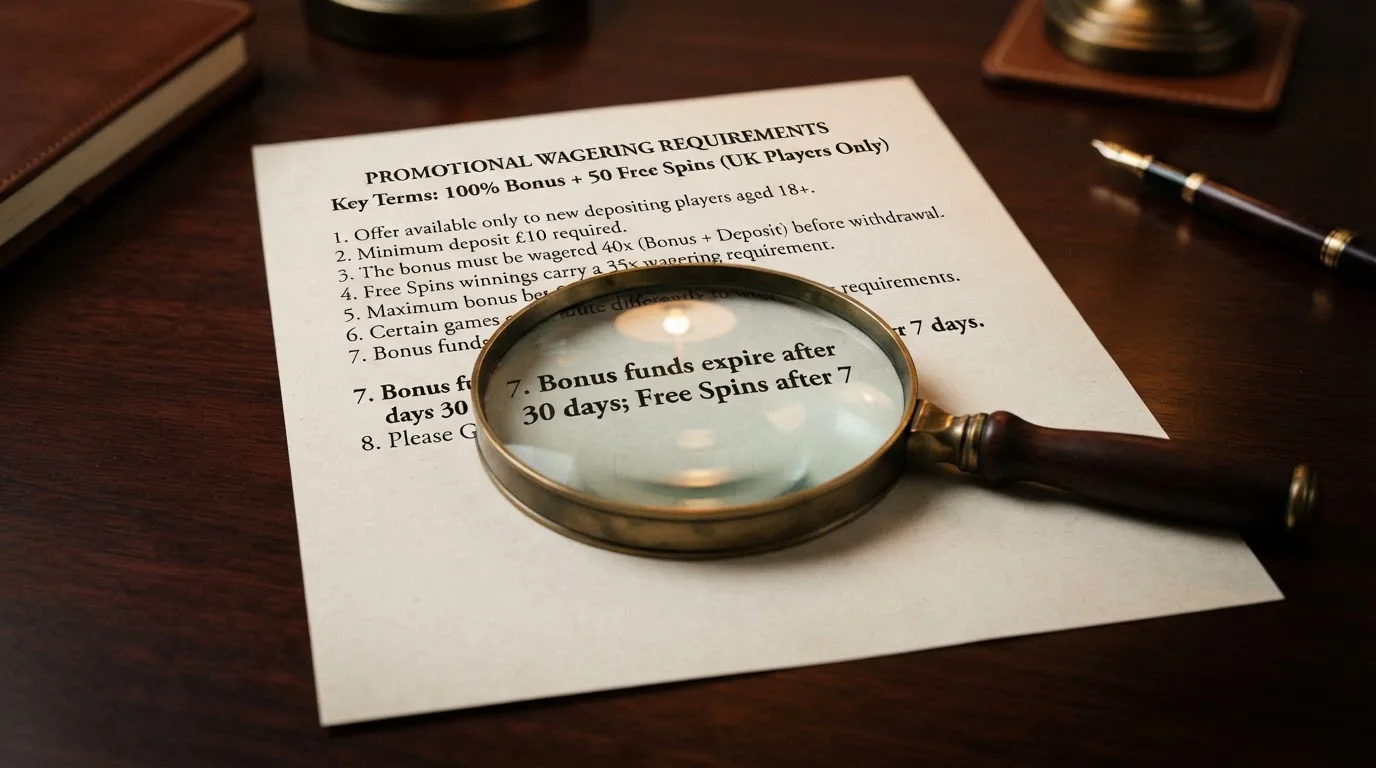
The test of whether a brand holds a licence is the Commission’s public register. The register can be searched online and downloaded in full as a CSV or Excel file, and on the snapshot taken for this article it listed 139 businesses holding an active remote casino operating licence. The register is not the market — it lists licence holders, some of whom run several sites, and it lists domains, each tagged against the licence account that runs it. A domain can carry one of three statuses: Active, Inactive or White Label, with 1065 active entries and 361 white-label entries on the snapshot. A white-label site trades under another company’s licence: the same operator runs the platform, but the brand on the door belongs to a marketing partner.
A remote casino licence number on the register has a fixed shape: six digits, the letter “R”, three more digits, a hyphen, six more digits. The leading six digits repeat the licence holder’s account number; the “R” marks the licence as remote (online); the trailing six digits are the licence sequence. Reading “039576-R-319370-028” tells a reader that the licence belongs to account 39576, is the twenty-eighth licence on that account, and is a remote licence. That string is what to look for on a casino’s footer — not a generic “regulated by” badge, not an offshore regulator’s number.
What GAMSTOP and identity verification mean for the offer
Every UK-licensed remote casino runs GAMSTOP checks before a player can deposit or play. GAMSTOP is the national self-exclusion scheme; a player who has signed up for six months, one year or five years cannot open an account, deposit or wager at any participating site until the chosen period ends and cannot cancel the exclusion early. The check runs at registration and again before any bonus is granted. A player who is on GAMSTOP does not see a 300% offer, because the offer does not reach them.
Identity verification is the second gate. Since 7 May 2019 every licensed operator has to verify the customer’s name, address and date of birth before the first deposit or any play, and confirm the customer is at least 18. The check pulls from public data and from the documents a customer submits on request. Anonymous play is not available at a licensed site. A brand that lets a player register with an email address and start playing without documents is offshore and unlicensed, whatever its marketing says.
A player who is neither on GAMSTOP nor in the verification queue receives the 300% offer under the brand’s standard terms. Two consequences worth flagging. First, the financial vulnerability check: from 28 February 2025 the operator runs a check at £150 net deposits in a rolling 30-day window using public data. The wider financial risk-assessment regime has been announced but is not yet in force. Second, the deposit-limit prompt: from 31 October 2025 the operator must ask the customer to set a financial limit before the first deposit is accepted. A player can decline to set one, but the prompt itself is mandatory and visible — it is not a banner that can be dismissed in a click.
Paying in and paying out: the rails that work for a 300% bonus
A 300% bonus is triggered by the deposit, not by the player. The rails a British player can use are narrower than they were five years ago, because credit cards are banned for gambling across all online and offline products in Great Britain since 14 April 2020. The ban includes credit-card-funded e-wallet top-ups: a player cannot load a credit card into PayPal or Skrill and then deposit from the wallet to a casino. Debit cards and bank transfers were never in scope, and most UK-licensed brands support both.
The practical rails on a UK-licensed casino are debit cards (Visa Debit, Mastercard Debit), bank transfers through the Faster Payments Service, PayPal and a handful of e-wallets such as Skrill and Neteller, Apple Pay on devices that support it, prepaid vouchers (paysafecard), and — at a small number of brands — cryptocurrency deposits.
A bank transfer through Faster Payments usually arrives within minutes; the service operates 24 hours a day, seven days a week, and most transfers clear instantly, with a ceiling of two hours for the longest tail. The scheme-level per-transaction limit sits at £1,000,000, although individual banks apply lower customer-level limits. A £20 minimum deposit on a 300% offer does not stress that limit. A withdrawal back to the same bank typically arrives the same day once the operator’s internal checks have completed.
Apple Pay is the rail that feels the smoothest at the deposit stage on a phone, because the card data is never shared with the casino. The tokenisation — replacing the real card number with a device-specific tokenised Device Primary Account Number and a dynamic security code per transaction — sits behind a double-click of the side button on Face ID models, or the Home button on Touch ID models. Apple Pay launched on 20 October 2014 supporting only US-issued cards and added UK-issued cards from 14 July 2015. Not every bank and not every card is supported, and Apple states that Apple Pay is not available in all markets — a player whose card sits outside the supported set falls back to a standard debit-card deposit.
Paysafecard deposits are the rail that the responsible-gambling framing most often sits behind. A paysafecard is a prepaid voucher bought with cash or debit in a shop and redeemed online by entering a 16-digit code; it does not require a bank account, and the deposit it funds is anonymous in the sense that no card number passes through the casino’s deposit form. The bonus the deposit unlocks is not anonymous: it still counts towards the player’s own spending limit, because the operator tracks it against the verified account. A player who intends to set a spending limit should set it before depositing by paysafecard, not after.
Crypto deposits are the rail the marketing tends to attach to the highest headline percentages. A 300% welcome bonus funded in Bitcoin, Ethereum or a stablecoin works the same way as a fiat deposit at the bonus level, but the deposit moves on a blockchain rather than through Faster Payments, and the operator’s KYC and GAMSTOP obligations still apply on the way out. No UK-licensed brand uses crypto as its only deposit rail; crypto sits beside debit cards and bank transfers where it is offered at all.
The wider point on payments is that the rail choice changes the player experience and not the bonus arithmetic. A £20 deposit by debit card, by Apple Pay, by paysafecard or by bank transfer triggers the same 300% match at the same operator, because the bonus is keyed to the deposit amount and the verified account, not to the rail.
The wagering cap in force since 19 December 2025
The single most important rule a 300% bonus sits under is the wagering cap. From 19 December 2025 the Gambling Commission banned any casino bonus whose wagering requirement exceeds 10x the bonus amount. A 300% bonus with a 30x or 40x wagering requirement is, on a UK-licensed site, no longer offered. The cap applies to the bonus element only, not to a deposit-plus-bonus combined turnover; the figure to read on the small print is “wagering: 10x bonus”, and a player has to stake ten times the bonus before it converts to cash.
The cap closes a market that used to be wide open. The licensed welcome offer at this scale now sits at a 10x multiple. A 300% match on a £100 cap means a maximum bonus of £300, which means a required turnover of £3,000 at the 10x ceiling, which a player clears by staking £3,000 across the games the operator counts toward wagering. The slot weighting is typically 100%, meaning every £1 staked counts as £1 against the requirement, but live casino and table games usually count at a lower percentage and some games are excluded entirely. The small print is where this lives.
A second rule that travels with the wagering cap is the ban on mixed-product bonuses. Since the same date, a brand cannot attach casino free spins to a sports bet, or a casino bonus to a poker deposit, as part of one promotional package. Each product has its own bonus, with its own 10x ceiling, and the cross-sell between them is closed.
The arithmetic the page is built around sits inside this cap. A £100 deposit at 300% produces a £300 bonus, which produces a £3,000 required turnover at the 10x wagering ceiling. Staked at £1 per spin on a slot — the operator’s usual maximum stake at the bonus stage — that is 3,000 spins. Played at one spin every five seconds, with a slot being legally barred from spinning faster than once every 2.5 seconds, the time to clear the bonus sits at roughly four hours and ten minutes of continuous play. The same £300 bonus cleared at a 50p stake takes 6,000 spins and roughly eight hours and twenty minutes. The 300% headline scales the bonus; the 10x cap fixes the conversion rate; the stake and the spin interval fix the wall-clock time.
Time limits, game weighting, and the small print that ends the bonus
A 300% bonus does not sit on the account indefinitely. Every UK-licensed welcome offer carries an expiry — usually 30 days from the bonus being credited, sometimes 14, sometimes 7. The expiry is on the wagering requirement, not on the cash balance. A player who has not cleared the bonus inside the window loses the bonus and any winnings tied to it. The rule is not negotiable and the operator’s terms set the exact window.
Game weighting is the second filter. Slots typically contribute 100% of the stake to wagering; roulette and blackjack usually contribute 10% to 20%; live casino games can be excluded entirely. A player who enjoys blackjack and tries to clear a 300% bonus on it will stake ten times as much as a slots player would at the same effective contribution. The weighting is published in the bonus terms; it is not on the homepage banner.
The third filter is the maximum stake at the bonus stage. UK-licensed brands usually cap the bonus stake at £5 per spin, which lines up with the £5 maximum stake on slots for players aged 25 and over in force since 9 April 2025, and £2 for players aged 18 to 24 in force since 21 May 2025. A player who bets above the bonus stake cap — even by accident, on a single spin — voids the bonus and any winnings tied to it. The rule is enforced by software, not by judgement.
The fourth filter is the maximum conversion. Some offers cap the amount of bonus that converts to withdrawable cash; a 5x cap on the bonus, for example, means a £300 bonus pays out at most £1,500 when cleared. A 300% bonus with no conversion cap is rarer and more valuable; the small print sets the figure.
The fifth filter is the bonus-abuse clause. The operator’s terms usually forbid strategies such as low-risk hedging bets (red and black on the same roulette spin) and require that the deposit be wagered at least once before withdrawal. A withdrawal request before the wagering is complete forfeits the bonus, and in some cases the winnings tied to it.
The point of listing these together is not to make the small print sound hostile. It is to show the reader what the 300% headline actually buys, which is a bonus with a defined conversion cost, a defined wall-clock time, a defined game menu, and a defined expiry. The maths below holds inside those constraints; the maths above the cap or outside the eligible games does not.
The featured brands and how they sit on the register
The ten brands below are taken from the Gambling Commission’s public register. Each domain is listed against the licence account that runs it. Several brands share one licensee: Ladbrokes, Coral and Gala Bingo all sit under LC International Limited, and the register is the proof of that, not a guess. Every brand below is GB-licensed and therefore takes part in GAMSTOP.
The bonus terms at each brand are not carried on the register. A “300% welcome bonus” headline on a brand’s homepage is marketing copy, not a licence condition, and the bonus figure on the register is the maximum bonus a brand can advertise under its LCCP — the Licence Conditions and Codes of Practice — not the offer running this week. The register is the licence test, not the promotion test.
BetVictor — the longer-established sportsbook with a casino alongside
BetVictor (Betvictor.com) holds an active listing on the Commission register for account 39576, BV Gaming Limited, with the remote casino operating licence 039576-R-319370-028. The brand has operated as a British-facing sportsbook since the mid-2010s and added a casino product in the same period, with the two products sharing one licence account.
Regarding the welcome bonus, BetVictor carries the same constraints as every other GB-licensed brand: a 300% match at a 10x wagering ceiling is the most the offer can stretch under current rules. Players should check the current promotion page for the specific cap and minimum deposit, as these figures change between campaigns.
The verdict on BetVictor is that it remains a stalwart of the older, sports-focused GB-licensed set. It runs on a single licence account, which a player who values consistency reads as stability, though a player who values frequent product revamps might find it less dynamic than the newer, niche-focused operators.
Betfair — the exchange brand’s casino arm
Betfair (Betfair.com) appears on the official register for account 39411, PPB Games Limited, which maintains the remote casino operating licence 039411-R-319335-010. The brand is better known for its betting exchange, with the casino serving as a secondary product on the same account.
Betfair’s casino welcome offer has historically been lighter than the exchange’s commission structure would predict. A 300% match represents the upper end of what a casino welcome offer runs to on a UK-licensed site, and the actual promotion is more often a deposit match at a lower percentage. Those who value the Betfair name are buying brand recognition rather than the highest available headline offer.
The verdict on Betfair is that the brand is ideal for those who already use the exchange and value the convenience of a unified account wallet. It is less compelling for a player whose primary motivation is chasing a 300% welcome headline, as Betfair tends to price its promotions more conservatively than the market’s upper promotional bounds.
kwiff — the newer brand with a higher headline on promotions
Kwiff (Kwiff.com) is listed for account 44448, Eaton Gate Gaming Limited, which holds the remote casino operating licence 044448-R-323408-017. The brand launched in the UK in the late 2010s, building its reputation through surprise promotional boosts that offer higher-than-expected bonus values.
Kwiff’s promotional mechanic often feels closer to the 300% headline than that of longer-established brands, because surprise boosts can lift the effective percentage above the published one. A 300% match on kwiff is a published promotion more frequently than it is on the traditional sportsbook-first brands.
The verdict on kwiff is that it is the brand a player picks when the welcome headline is the reason for opening, because its promotional structure is built around offering a higher-than-expected figure rather than a long-running loyalty scheme. The licence account is newer than the sportsbook-first brands’, which a player who values a longer track record reads as a shorter one.
Ladbrokes — the high-street name running on a single licence account
Ladbrokes (Ladbrokes.com) maintains an active licence entry under account 54743, LC International Limited, with the remote casino operating licence 054743-R-330863-014. The brand is one of three in this set — alongside Coral and Gala Bingo — that share this licence account, meaning a player holding an account with one cannot open a duplicate on a sister brand without operator consent.
Ladbrokes’ casino offer has historically been a deposit match at a moderate percentage with a more stable, long-running loyalty structure than what is found at the surprise-boost brands. A 300% match represents the upper bound of the Ladbrokes range rather than the standard entry offer.
The verdict on Ladbrokes is that it trades heavily on its high-street legacy and name recognition rather than trying to win with the largest headline offer. A player who arrives specifically via a 300% match should weigh the welcome bonus against the long-term loyalty structure, which offers more sustainable value than the headline promotional ceiling.
Virgin Games — a white-label on the Gamesys licence account
Virgin Games sits on the Commission register as a white-label domain of account 38905, Gamesys Operations Limited, holding the active remote casino operating licence 038905-R-319430-022. The white-label status is the point: Virgin Games trades under another company’s licence, and the brand on the door — Virgin — sits on the Gamesys platform rather than on a Virgin-owned licence.
White-label sites operate under the same GAMSTOP and verification regime as any other GB-licensed site, as the licence is the key factor. The 300% headline, where it appears on Virgin Games, reflects the Gamesys promotional structure rather than a brand-unique strategy.
The verdict on Virgin Games is that the white-label status matters less than it sounds — the player protection regime is identical to a brand that holds its own licence — and matters more than it sounds for the bonus, because a white-label site tends to share its promotional structure with sister brands on the same licence account. Jackpotjoy sits on the same Gamesys account and runs a comparable welcome offer; a player who is choosing between them is choosing between two front doors on the same platform.
Betway — the multi-product brand with a casino focus
Betway (Betway.com) holds a remote casino operating licence, 039372-R-319367-029, registered to account 39372, Betway Limited. The operator provides a sportsbook, casino and poker product on this same licence account, with the casino generally featuring the most prominent share of welcome promotions.
Betway’s casino welcome offer has historically sat at a moderate percentage with a low minimum deposit and a short expiry window. A 300% match represents the top of the Betway range and is run less frequently than lower-percentage deposit matches paired with more generous deposit caps.
The verdict on Betway is that it sits in the middle of the GB-licensed market — longer-established than kwiff, more casino-focused than the sportsbook-first brands, and more often a 100% or 200% match than a 300% one. A player who arrives for the headline should treat the 300% as the upper bound and check the current promotion page for what is actually running.
Jackpotjoy — the Gamesys sister to Virgin Games
Jackpotjoy (Jackpotjoy.com) is registered to account 38905, Gamesys Operations Limited, which holds the remote casino operating licence 038905-R-319430-022. The brand shares its licence account and underlying platform with Virgin Games, meaning the promotional structures are comparable across both sites.
The Gamesys welcome structure is shared across both brands, meaning a 300% match at Jackpotjoy is comparable to a 300% match at Virgin Games in terms of cap, minimum deposit and wagering requirement. The distinction lies in the lobby — bingo-focused on Jackpotjoy, casino-and-slots-focused on Virgin Games — and the welcome offer is tuned to match that focus.
The verdict on Jackpotjoy is that it sits in the bingo-and-slots end of the Gamesys platform and is the right brand for a player who wants bingo alongside the slots welcome offer. The same caveat applies as on Virgin Games: a player who is choosing between the two is choosing between two front doors on the same licence account.
Betfred — the high-street bookmaker’s casino arm
Betfred (Betfred.com) sits on the Commission register as an active domain of account 39544, Petfre (Gibraltar) Limited, holding the active remote casino operating licence 039544-R-319290-010. The brand is one of the longest-established high-street bookmakers in Britain, and the casino sits on the same licence account as the sportsbook.
Betfred’s casino offer has historically been a moderate deposit match with a sportsbook-crossover structure, which the December 2025 ban on mixed-product bonuses has simplified. A 300% match sits at the upper end of the Betfred range and appears less frequently than the lower-percentage offer that carries a longer expiry.
The verdict on Betfred is that it caters well to players who already hold a high-street shop account and appreciate the ability to use the same wallet online. For those motivated purely by the 300% headline, however, it is important to remember that this offer represents the operator’s maximum promotional ceiling, not the standard offer found on most days.
Sky Vegas — the broadcast brand’s casino arm
Sky Vegas sits on the Commission register as an active domain of account 65519, Bonne Terre Gaming Limited, holding the active remote casino operating licence 065519-R-339675-002. The brand runs on a licence account held by Bonne Terre Gaming Limited rather than by Sky directly, and the casino is the primary product rather than a sportsbook crossover.
The subject of this page is the welcome bonus, and Sky Vegas’ casino offer has historically been a slot-focused deposit match with a moderate percentage. A 300% match is at the top of the Sky Vegas range and runs less often than the standard offer.
The verdict on Sky Vegas is that it focuses heavily on a slots-first experience, making it a strong choice for players who want a streamlined product without the distraction of sportsbook or bingo crossovers. The standard 10x wagering cap applies here, and it is worth noting that any advertised bonus remains subject to the operator’s prevailing promotional limits.
888casino — the longest-established casino-only brand in the set
888casino (888casino) sits on the Commission register as an active domain of account 39028, 888 UK Limited, holding the active remote casino operating licence 039028-R-319297-014. The brand is one of the longest-running casino-only operations in the GB-licensed market and runs on a licence account held by 888 UK Limited.
The subject of this page is the welcome bonus, and 888casino’s welcome structure has historically sat at a moderate-to-high percentage with a slot-heavy weighting scheme. A 300% match is at the upper end of the 888casino range and is more likely to appear on 888casino than on the sportsbook-first brands.
The verdict on 888casino is that it sits in the casino-only end of the GB-licensed market and is the right brand for a player who wants a casino product without a sportsbook attached. The licence account is older than the surprise-boost brands’, which a player who values track record reads as stability.
Comparing the brands across the licence fields
The table below arranges the ten brands against the four licence-side fields the register carries. The bonus terms themselves are not on the register, and so the table does not carry a bonus column — every brand here operates under the same 10x wagering cap and the same GAMSTOP and verification regime, and a bonus-by-bonus comparison belongs on the live promotion pages rather than on a register-based table.
| Brand | Licence holder and GB remote casino licence | Domain status on the register |
|---|---|---|
| BetVictor | BV Gaming Limited (39576) — 039576-R-319370-028 | Active |
| Betfair | PPB Games Limited (39411) — 039411-R-319335-010 | Active |
| kwiff | Eaton Gate Gaming Limited (44448) — 044448-R-323408-017 | Active |
| Ladbrokes | LC International Limited (54743) — 054743-R-330863-014 | Active |
| Virgin Games | Gamesys Operations Limited (38905) — 038905-R-319430-022 | White Label |
| Betway | Betway Limited (39372) — 039372-R-319367-029 | Active |
| Jackpotjoy | Gamesys Operations Limited (38905) — 038905-R-319430-022 | Active |
| Betfred | Petfre (Gibraltar) Limited (39544) — 039544-R-319290-010 | Active |
| Sky Vegas | Bonne Terre Gaming Limited (65519) — 065519-R-339675-002 | Active |
| 888casino | 888 UK Limited (39028) — 039028-R-319297-014 | Active |
The column to read first is the licence-holder column. Three licence holders carry two or more of the brands in the table: LC International Limited runs Ladbrokes (with Coral and Gala Bingo not featured here), and Gamesys Operations Limited runs both Virgin Games and Jackpotjoy. A player who already holds an account with one of those brands cannot open a duplicate on a sister brand under the same licence account without operator consent, and the GAMSTOP check applies across the licence regardless of brand.
The column to read second is the domain status. Nine of the ten brands sit on the register as Active domains, and one — Virgin Games — sits as a White Label. The white-label status is not a downgrade in player protection; GAMSTOP and identity verification run identically on a white-label site because the licence is the licence. The status is information about the brand’s commercial structure rather than about the player experience.
The column the table does not carry is the bonus. The register does not carry promotion terms, and a brand-by-brand promotion comparison would need current data from each operator’s promotion page. The table’s job is to show the licence field the register actually carries, not to dress it up as a promotion comparison.
Who the offer actually suits
A 300% match with a 10x wagering ceiling and a £100 cap is a low-deposit, high-time offer, not a high-deposit, low-time offer. The arithmetic decides this. A £20 minimum deposit produces a £60 bonus and £600 of turnover, which a player clears in well under an hour at any stake the operator permits. A £100 deposit at the cap produces a £300 bonus and £3,000 of turnover, which clears in roughly four hours at £1 per spin. Above the cap, the bonus does not grow, and a player who deposits £500 to chase a non-existent fourth-of-the-bonus gets the same £300 bonus and the same £3,000 of turnover as a £100 deposit.
The player the offer suits is the one who plays slots at a moderate stake, intends to clear the bonus rather than withdraw before clearing, and is happy to set a financial limit before the first deposit to keep the budget honest. The deposit-limit prompt that has been mandatory since 31 October 2025 sits in front of the bonus, and a player who skips it and chases the bonus above the budget they would have set is the player the rule exists for.
The player the offer does not suit is the one who prefers table games, because the game weighting cuts the effective contribution and the wagering requirement stretches. A 100% match with a 20% table weighting clears in the same wall-clock time as a 300% match with a 100% slot weighting at the same bonus; the percentage is the wrong lever to pull if the game is wrong. The same holds for a player who wants to withdraw the bonus cash rather than play it through: the bonus is not a cash equivalent, and a player who treats it as one will discover the conversion cost the hard way.
A final framing. The “quadrupling” headline is the marketing line; the conversion cost is the player’s line. A £20 deposit at 300% and 10x wagering produces £600 of turnover, which is roughly four hours of play at £1 per spin. That is a long afternoon for a £20 deposit, and a reader who treats the headline as a windfall has not read the small print. The reader who treats it as a fixed conversion cost — a defined number of spins at a defined stake inside a defined window — is the reader who makes the offer work.
What to do before claiming
Three checks sit in front of the 300% claim. First, the licence check: the brand’s footer should carry the Commission licence number in the form six-digits-R-six-digits-six-digits, and the brand should appear on the public register with an Active or White Label domain. If the number is absent or the register has no entry, the site is unlicensed. Second, the rail check: the deposit rail should not be a credit card (banned since 14 April 2020) and should not be a credit-card-funded e-wallet top-up. A debit card, a bank transfer through Faster Payments, Apple Pay on a supported device, a paysafecard voucher, or a PayPal balance funded from a debit card are all in scope. Third, the limit check: a financial limit should be set before the first deposit, because the operator’s prompt is mandatory and the limit the player sets is the one the bonus is then played against.
Two further checks sit behind the claim. The bonus terms should carry a wagering requirement that does not exceed 10x the bonus, and the small print should name the eligible games, the maximum stake at the bonus stage and the expiry window. A promotion that does not carry those figures in the terms is one the player should not claim on the assumption that the operator will fix them later.
The offshore alternative and what it costs
A 300% match with a 30x or 40x wagering requirement is, on a UK-licensed site, no longer offered. The same headline is freely offered by offshore brands, and a player who searches for “300% bonus” online will meet them. The trade is simple: a higher headline and a higher wagering requirement, in exchange for the loss of every protection the Commission regime provides.
A player on an unlicensed site has no GAMSTOP screen — a self-excluded player who has signed up for six months, one year or five years can still open an account on an offshore brand, because the brand does not run the check. A player on an unlicensed site has no Commission complaints route — disputes go to the brand’s own terms or to the brand’s home regulator, which in Curaçao or Malta is less accessible than the Commission. A player on an unlicensed site has no approved ADR — there is no independent body the player can escalate to once the brand’s own customer service has failed. A player on an unlicensed site has no deposit-limit prompt and no financial vulnerability check, because the rule is a Commission rule and not a universal one.
The Commission disrupts unlicensed sites that target British customers — cease-and-desist notices, search-engine delisting, payment and hosting referrals — but has no power to block them at the ISP level. The penalty is aimed at the operator, not the player; no British player has been prosecuted for playing on an unlicensed site. What the player loses is the protection regime, not the right to play.
The arithmetic comparison is also unkind. A £100 deposit at 300% with a 30x wagering requirement is a £9,000 turnover requirement, against £3,000 under the Commission cap. A 300% bonus at 10x on a UK-licensed site is the offer; a 300% bonus at 30x on an unlicensed site is the same headline number at triple the conversion cost. The unlicensed brand does not have a better offer — it has a worse one wearing a better headline.
The signals that a brand is unlicensed
Three signals should put a player off. First, no Commission licence number on the site footer, or a licence number that does not resolve on the public register. Second, a deposit page that accepts credit cards (banned for British gambling since 14 April 2020) or a crypto-only deposit page with no debit-card or bank-transfer option (a Commission-licensed brand cannot offer credit cards but does offer debit cards and bank transfers, because anonymous crypto play is incompatible with the verification regime). Third, a registration flow that lets a player deposit and play before submitting identity documents, or no GAMSTOP check at the registration stage.
A player who finds any of these should assume the site is offshore and unlicensed and should not deposit. The same 300% headline on a Commission-licensed brand at a 10x wagering ceiling is the right shape of the offer; a higher percentage at a higher wagering multiple on a site that does not run the Commission’s checks is not.
How the 10x wagering cap closes a market
Before 19 December 2025 the GB-licensed welcome market ran from a 100% match at a 40x wagering requirement to a 300% match at a 30x wagering requirement. The 10x cap closed the upper end of the wagering range and tightened the market around offers where the percentage and the wagering requirement were already in line with the new ceiling. A 300% match at 10x is the offer that fits the cap; a 100% match at 10x is the offer that sits well inside it; a 300% match at 30x is the offer that no longer runs on a Commission-licensed site.
The market’s own movement since the cap came in has been toward the cap. Operators that ran a 300% match at 30x have moved to a 100% or 200% match at 10x, or to a 300% match at 10x with a lower cap. Operators that ran a 100% match at 40x have moved to a 100% match at 10x with a higher cap. The wagering cost is the variable that changed; the percentage is the variable that absorbed the change.
The result is a tighter, more legible market. A player comparing two GB-licensed brands on the welcome offer is comparing two offers at the same wagering ceiling, with the percentage, the cap, the minimum deposit and the eligible games as the differentiators. A player comparing a GB-licensed brand with an offshore brand is comparing a 10x ceiling with a 30x or 40x ceiling, and the headline percentage is the smaller of the two differences.
The case for reading the licence number, not the headline
A 300% match is the largest welcome offer the GB-licensed market runs, and it runs at the wagering ceiling in force since 19 December 2025. A player who arrives at the offer without checking the licence is reading a marketing line; a player who arrives at the offer with the licence number in hand is reading an offer that has a defined conversion cost. The Commission register is the place to check, and the licence number is the string to look for.
The register is public and downloadable as a CSV file. The full register on the snapshot taken for this article listed 139 active remote casino licence holders, 1,065 active domains and 361 white-label domains. That is the universe of brands that can lawfully take a British deposit on a casino product. The ten brands above are a subset of that universe, chosen for the spread of licence holders and the variety of brand structures — sportsbook-first, casino-only, white-label, multi-product, broadcast brand, high-street legacy. A player who wants the full set can download the register; a player who wants a worked example can read the table above and follow the licence number through to the Commission’s site.
The bottom line on the offer
A 300% casino bonus quadruples a player’s first deposit up to a cap and runs under a 10x wagering ceiling on every GB-licensed brand. The deposit that triggers the full offer is the cap, not the percentage above it; the bonus stops scaling at the cap, and the wall-clock time to clear it is set by the stake and the spin interval, not by the deposit. The conversion cost is the wagering requirement times the bonus, and the time cost is the spins the wagering requires. A reader who treats the headline as the offer is missing the conversion cost. A reader who treats the conversion cost as the offer is reading what the headline actually buys.
The licence is the test of whether the brand can pay the offer at all. The register is the test of whether the brand holds the licence. The 10x cap is the test of whether the offer is the offer the marketing line claims. A 300% match on a GB-licensed brand at a 10x wagering ceiling is the right shape of the offer a player should be reading; a 300% match at a higher wagering multiple on a brand that does not appear on the register is the same headline wearing a higher cost.
Frequently asked questions
How does a 300% casino bonus work?
A 300% bonus adds three times the deposit to the playable balance, on top of the deposit itself. A £20 deposit produces £80 of playable funds — £20 cash and £60 bonus — and the £60 is locked until its wagering requirement is met. The bonus carries a cap, a minimum deposit, a wagering multiple and an expiry window, all set out in the terms.
What deposit size is usually needed to unlock a 300% match?
The minimum is set by the operator and typically sits at £10 or £20. The cap is also set by the operator — £100 is common — and the bonus stops scaling above it. A £500 deposit at a £100 cap still produces a £300 bonus, because the cap is the ceiling on the bonus, not on the deposit.
Can I claim a 300% bonus with paysafecard?
Paysafecard deposits are accepted by most GB-licensed brands and trigger the welcome offer the same way a debit-card deposit does. The bonus is not anonymous, because the operator tracks it against the verified account, and a player who intends to set a spending limit should set it before depositing.
What wagering requirement applies to a 300% deposit match under current UK rules?
From 19 December 2025 the wagering requirement on any casino bonus at a GB-licensed brand is capped at 10x the bonus amount. A 300% match with a 30x wagering requirement is no longer offered on a UK-licensed site, because the requirement exceeds the ceiling.
Do crypto deposits qualify for a 300% welcome bonus?
A GB-licensed brand that accepts crypto accepts it as a deposit rail, and the bonus is keyed to the deposit, not the rail. The verification and GAMSTOP obligations apply on the way out, and no GB-licensed brand uses crypto as its only deposit option.
Is there a time limit to use a 300% bonus?
Yes. The wagering requirement carries an expiry — typically 30 days from the bonus being credited — and the bonus is forfeit if the requirement is not met inside the window. The expiry is on the wagering, not on the cash balance.