
No wagering casino UK 2026: how wager-free offers actually work
What a no wagering casino in the UK actually pays, and what it costs you
Data current as of 8 November 2026 and cross-checked against the Gambling Commission’s public register of gambling businesses.
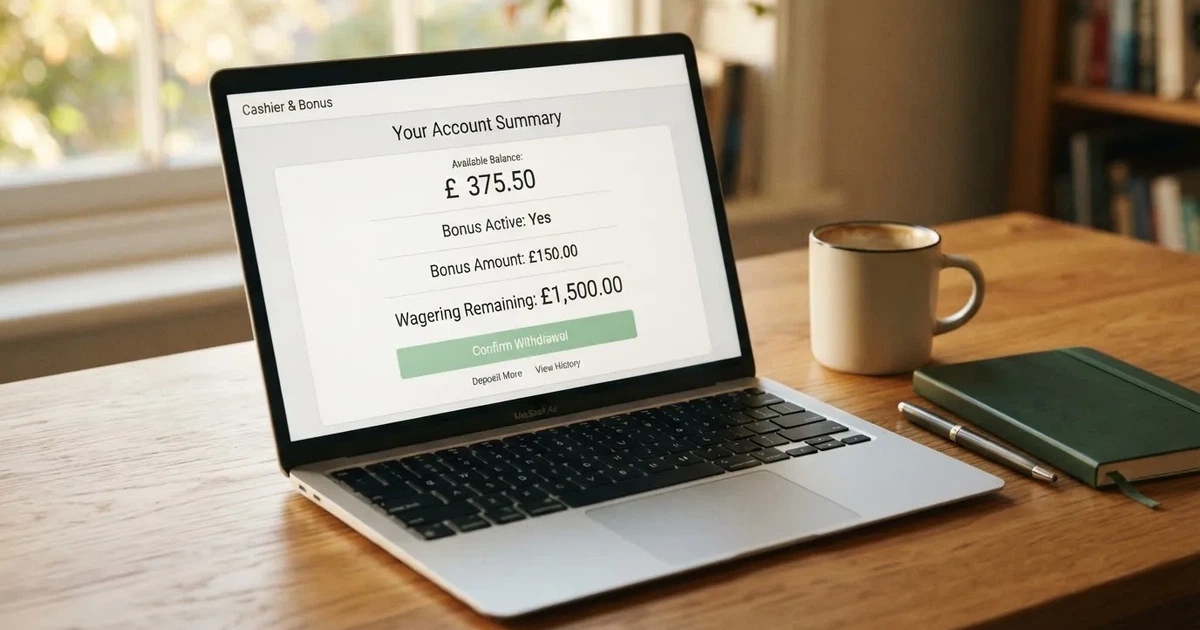
The phrase sells a feeling: deposit, play, withdraw, no playthrough. A wager-free bonus is the one casino promotion that promises what most promotions do not, and the reason it sits on the homepage is that, until recently, the alternative was a 30x or 40x grind. Since 19 December 2025 the Commission has capped any wagering requirement a UK-licensed operator may set at 10x, and the page below is the honest read of what that shift has done to the market. It covers ten Gambling Commission-licensed brands, the structural mechanics behind a wager-free offer, the deposit and withdrawal rails, the safer-gambling harness every one of them sits inside, and the calculation that tells you how much clearing a bonus-sized turnover actually takes at the new ceiling.
Table of Contents
- The ten UK-licensed brands ranked, and what each one is on the register
- How the wagering cap changed the market, and why “no wagering” still matters
- The mechanics of a wager-free bonus, line by line
- The safer-gambling harness every UK no-wagering casino sits inside
- The crypto and identity question, and why “no wagering” does not mean “anonymous”
- Payments, payout speed, and the rails a UK-licensed casino sits on
- The bonus comparison that decides which offer is worth taking
- The operator reviews, ranked in the order the register sets
- What the register is telling the reader that the marketing is not
- Frequently asked questions
The ten UK-licensed brands ranked, and what each one is on the register
The ranking below is built from the Commission’s own public register. Each row carries the licence holder and the licence number that the domain is listed against, then the status the register gives that domain (Active, Inactive, or White Label — a white-label site trades under another operator’s licence rather than its own). The Subject support column records what the register confirms about whether the brand runs wager-free offers. Where the register does not speak to a wager-free stance, the cell carries the no-data marker rather than an invented claim.

| Brand | Licence holder and GB remote casino licence | Domain status on the register | Subject support |
|---|---|---|---|
| Virgin Games | Gamesys Operations Limited, 038905-R-319430-022 | White Label | — |
| Casumo | Recro Limited, 061549-R-336718-002 | Active | — |
| Ladbrokes | LC International Limited, 054743-R-330863-014 | Active | — |
| Betfair | PPB Games Limited, 039411-R-319335-010 | Active | — |
| PokerStars | Stars Interactive Limited, 039108-R-319334-026 | Active | — |
| Gala Bingo | LC International Limited, 054743-R-330863-014 | Active | — |
| 32Red | Platinum Gaming Limited, 045322-R-324275-019 | Active | — |
| Coral | LC International Limited, 054743-R-330863-014 | Active | — |
| Sky Vegas | Bonne Terre Gaming Limited, 065519-R-339675-002 | Active | — |
| Paddy Power | PPB Games Limited, 039411-R-319335-010 | Active | — |
Three things the table is telling you, and three it is not. It tells you that the ten brand names run on only seven licence accounts — Ladbrokes, Coral and Gala Bingo all sit under LC International Limited; Betfair and Paddy Power both run on PPB Games Limited. It tells you which domains are white-label (Virgin Games) and which the register lists as direct (every other brand above). And it tells you that the register itself does not record whether an operator is currently running a wager-free promotion, which is why the Subject support column is empty for every row. What the table is not doing is grading these brands against each other. The licence numbers and the licensee identities are the data the register actually publishes; whether one of these brands is a better place to play than another is a judgement the rest of the page earns.
Virgin Games — the only white-label in the set
Virgin Games trades on Gamesys Operations Limited’s licence, account 38905, and is the one white-label row in the table. A white-label arrangement means the brand identity is Virgin’s, but the licence, the platform and the safer-gambling controls behind it are Gamesys’s — so any complaint, any GAMSTOP match, any dispute resolution route runs to Gamesys, not to a separate Virgin entity. The arrangement is legal under the Commission’s structure and is common in the market; what it changes for the player is the entity on the other side of an ADR case. For most players the difference is invisible; for anyone who has ever needed to escalate, it is not.

Casumo — the standalone licence that looks the cleanest
Casumo is the one row in the table whose domain is listed as Active against a single-operator licence (Recro Limited, account 61549) without sharing the licence with another major brand. The licence lineage is short and unencumbered, which makes the ADR picture straightforward. Whether that translates into a better wager-free offer is something the rest of the page addresses, not the register.
Ladbrokes, Gala Bingo, Coral — one licence, three front doors
LC International Limited holds licence 054743-R-330863-014, and Ladbrokes, Gala Bingo and Coral are all three listed against it as Active domains. They share the same compliance team, the same payments stack, the same GAMSTOP wiring and the same safer-gambling prompts. They compete on product mix (Ladbrokes is sports-led, Coral blends casino and sports, Gala Bingo sits on bingo and slots) rather than on the underlying rules. A wager-free promotion offered on one of the three tends to be mirrored across the others, sometimes with a different headline number, sometimes with the same headline on different products. The reader comparing these three is, in practice, choosing a product surface rather than a different operator.
Betfair and Paddy Power — PPB Games Limited, two product fronts
PPB Games Limited, account 39411, runs licence 039411-R-319335-010 and lists both Betfair and Paddy Power as Active. Betfair carries an exchange and a casino; Paddy Power sits on sports and a casino. The two have historically been the most aggressive movers on bonus design in this set, which is the reason they sit on the same licence rather than the same product. A wager-free offer on one is the prompt to check the other; the underlying economics are the same because the licence is the same.
PokerStars — Stars Interactive, on its own licence
Stars Interactive Limited holds licence 039108-R-319334-026 and lists PokerStars as Active. The brand is the most product-distinct in the table — poker is its centre of gravity, and the casino offering sits beside it rather than beneath it — but the licence is its own, which is why it is not folded into another row.
32Red — Platinum Gaming, long-running licence
Platinum Gaming Limited, account 45322, holds licence 045322-R-324275-019 and lists 32Red as Active. 32Red is one of the longer-tenured UK casino brands still trading under its original licensee, and the licence lineage shows it. The product mix is casino-led; bingo, poker and sports are not the centre of gravity.
Sky Vegas — Bonne Terre Gaming, the newest licence in the set
Bonne Terre Gaming Limited, account 65519, holds licence 065519-R-339675-002 and lists Sky Vegas as Active. Sky Vegas is the youngest licence in the table; the wider Sky-branded gambling operation sits across multiple Commission accounts, and Sky Vegas is the casino-only line.
How the wagering cap changed the market, and why “no wagering” still matters
On 19 December 2025 the Gambling Commission brought a 10x cap into force on any wagering requirement attached to a casino bonus, and banned mixed-product bonuses where one product (a sports bet) unlocks another (casino spins). Before that date the standard UK bonus carried a 30x to 40x turnover multiple — a £100 bonus meant £3,000 to £4,000 of play before a withdrawal was permitted — and the difference between a standard bonus and a wager-free one was the difference between a job and a non-job.
The 10x cap shrinks that gap sharply. A £100 bonus at 10x is £1,000 of required play. The clearing time is no longer the wall between the player and the withdrawal; the question is whether the casino’s maths leaves the player better off taking the bonus, the wager-free alternative, or no promotion at all. The wager-free label is not redundant in a 10x world — it is a label for the operator that did not bother with a multiple at all, either because the bonus is small or because the operator’s economics do not need one.
The phrase “no wagering” is not a regulatory term. Nothing in the Gambling Act 2005 or the LCCP requires an operator to use any particular phrase for a bonus that does not carry a playthrough. What the page is describing, then, is a marketing label, not a regulated product. That matters because the label can travel further than the offer: a wager-free banner on the homepage can sit above a bonus that does carry a turnover requirement on a sub-page, or above a free-spin offer whose winnings are themselves capped at a low figure. The label is not the offer; the offer’s terms are the offer.
Why a wager-free offer is still sustainable
The question that gets asked when the marketing lands is the obvious one: if there is no playthrough, what stops the player depositing, taking the bonus, and walking away with the winnings? Three answers, in the order an operator would reach for them.
The first is the size of the bonus. A wager-free bonus is typically smaller than a standard one, because the operator is not asking the player to put £4,000 of play behind it. £10 or £20 of wager-free bonus on a first deposit is a common headline; £200 is not.
The second is the cap on winnings. A wager-free promotion frequently carries a maximum cashout figure attached to the bonus balance — £50 of winnings, say, on a £10 bonus. The cap is what closes the door the missing playthrough would otherwise leave open.
The third is the eligible games. Some wager-free offers are restricted to a small slot catalogue, where the house edge is wider and the operator’s economics absorb the lack of a playthrough.
The reader who knows the market recognises all three. The reader who meets the label for the first time usually does not, and the rest of the section is a sharper read on the costs each of those three answers imposes.
The cost of a cap on winnings
A cap is the wager-free promotion’s hidden edge. A £10 bonus with a £50 cashout cap pays out up to five times the bonus; anything above that line is forfeited on withdrawal, regardless of what the slot did. The arithmetic reads small in pounds and large in probability: at a 96% RTP slot, the chance of a £10 bonus producing more than £50 in a session is low but not negligible, and the operator is paying itself to take that probability off the table. For a player who would otherwise have played the bonus through anyway, the cap is the part that turns a bonus from a genuine offer into a marketing word.
The cost of an eligible-games restriction
A wager-free offer limited to one or two slots restricts the player’s choice in a way the marketing does not say. The house edge on those slots is typically wider than the house edge on the rest of the catalogue. The reader who treats a wager-free promotion as a free ride is being asked, in effect, to play the games the casino most wants played. The wider the catalogue the operator opens up, the more generous the offer; the narrower it, the more the operator is shaping the player’s behaviour in its own interest.
The mechanics of a wager-free bonus, line by line
A wager-free offer looks like a standard bonus with one line crossed out. The mechanics that survive the crossing-out are the ones that decide what the offer is worth, and they are worth going through.
The bonus type
A wager-free offer comes in two shapes. A cash bonus is a sum added to the account that can be withdrawn at any time, with no playthrough attached. A free-spin bundle is a set of spins on a named slot, with the spin winnings paid as cash or as bonus funds; the wager-free label usually means the winnings are paid as cash. The two shapes carry different maths — a £10 cash bonus and 50 wager-free spins at £0.10 are not equivalent, and the difference is not always visible in the headline.
The minimum deposit
Wager-free offers are gated by deposit, sometimes by a specific deposit method. A £10 minimum deposit to claim a £10 wager-free bonus is the common form; a £20 minimum is the higher end. The deposit requirement is the read on whether the offer is targeted at small-stake players or at the broader deposit base.
The maximum bet size during a bonus
A wager-free offer does not always drop the maximum bet size during the bonus balance. The Commission’s stake limits — £5 per spin for players 25 and over (from 9 April 2025), £2 for 18-24 (from 21 May 2025) — apply to the underlying game, not to the bonus; an operator can and does set a lower bonus-time bet cap (typically £2 or £5 per spin) for the duration of the bonus balance. The cap matters more on a standard playthrough bonus than on a wager-free one, because on a wager-free bonus there is no playthrough to protect; but it remains a restriction on what the player can do with the bonus funds before they become cash.
The maximum cashout cap
This is the wager-free offer’s most consequential line. A cap on bonus-derived winnings is the mechanism the operator uses to close the door the missing playthrough would otherwise leave open. A £10 wager-free bonus with a £50 cashout cap is, in effect, a £50 promotion; a £10 wager-free bonus with no cap is a different category of offer altogether. The reader comparing wager-free labels should compare the cashout caps as carefully as the bonus sizes.
The eligible games
A wager-free offer is rarely universal across the catalogue. Slots only, or a short slot list, or a single named slot, are common shapes. Live casino and table games are usually excluded because the house edge there is narrower and the operator’s economics on a wager-free promotion are tighter. The eligible-games list is the read on how much of the catalogue the player is actually being offered.
The expiry
A wager-free bonus carries an expiry — typically seven days from issue, sometimes thirty. Anything unused by the deadline is forfeited. The expiry matters because the wager-free offer does not extend the time the player has to clear; if anything, it shortens it, because there is no playthrough to absorb the buffer.
The safer-gambling harness every UK no-wagering casino sits inside
A wager-free label does not exempt an operator from the rest of the Commission’s social responsibility code. The tools below apply to every Gambling Commission-licensed online casino in this set, wager-free or not, and the reader who treats the wager-free label as a softer regulator is reading the wrong page.
Identity verification before first play
Name, address and date of birth are verified before the first deposit or any play — the rule has been in force since 7 May 2019, and applies regardless of whether the operator runs a wager-free promotion. A wager-free casino is not a no-verification casino; the licence requires the checks, and the checks have to happen before the bonus is credited. For the player, this is the moment a “no wagering” label meets the Commission’s actual rulebook, and the two are not the same thing.
The 10x cap and its consequences
The 10x wagering cap, in force since 19 December 2025, is the headline rule that has reshaped the market this page is about. It does not apply to wager-free offers — those have no wagering requirement to cap — but it does apply to every non-wager-free offer on the same site. A reader comparing two sites on their bonus design is comparing a wager-free offer on one against a 10x-capped offer on the other, and the comparison only makes sense if the reader knows what the 10x ceiling looks like in pounds. The arithmetic below in the calculation section is the answer to that question.
Stake limits by age
From 9 April 2025 the maximum stake per game cycle on an online slot is £5 for players 25 and over; from 21 May 2025 the same limit is £2 for players aged 18-24. The rule is about the underlying game, not the bonus, and a wager-free offer cannot raise the limit. For a player on a wager-free bonus who would otherwise have bet higher, the rule is the binding ceiling.
GAMSTOP self-exclusion
Every Gambling Commission-licensed online operator is required to take part in GAMSTOP, the national online self-exclusion scheme, since 31 March 2020. A self-exclusion can be set for six months, one year or five years and cannot be cancelled early. A wager-free casino account is, in this respect, identical to a standard-bonus account — the GAMSTOP match runs at sign-up, and a self-excluded player cannot open an account on any of the ten brands in the ranking regardless of what bonus structure they run. The reader who treats “wager-free” as a route around GAMSTOP is reading the wrong regulation.
Financial vulnerability checks
From 28 February 2025 operators run a financial vulnerability check at £150 net deposits in a rolling 30-day window, using public data only. Wider financial risk assessments have been announced but are not yet in force. A wager-free promotion does not exempt an account from these checks; the deposit that funds the bonus counts toward the £150 threshold the same way any other deposit does.
The mandatory deposit-limit prompt
Since 31 October 2025 operators must prompt a customer to set a financial limit before the first deposit. The prompt is required regardless of whether the account is opened to claim a wager-free promotion, and the limit the player sets applies to the account’s deposit ceiling from that point on. A wager-free promotion is not a route to an unlimited deposit profile.
The 2.5-second spin minimum and the auto-play ban
Since 31 October 2021 a slot spin may not be faster than 2.5 seconds and auto-play is banned. “Losses disguised as wins” — a spin that returns less than the stake accompanied by a celebratory animation — are banned. These rules apply to every slot on every UK-licensed site, and they shape what a wager-free bonus can be played on, because the eligible-game list is read against a catalogue whose spin pace is fixed.
The crypto and identity question, and why “no wagering” does not mean “anonymous”
The search phrase “no wagering crypto casino” is the one the reader is most likely to have landed here from, and it is the one this section handles head-on.
A wager-free casino is not anonymous
The identity verification rule is in force since 7 May 2019, applies to every Gambling Commission-licensed operator, and runs before first deposit or first play. The wager-free label is not an exemption; the operator runs the same KYC stack on every account, bonus structure or no bonus structure. The reader who arrived here expecting a way to play without sending documents is reading the wrong section.
Crypto deposits at a UK-licensed casino
The Commission’s stance on crypto deposits at licensed online casinos is restrictive: most UK-licensed operators do not accept crypto as a deposit method because the payment chain does not feed cleanly into the Commission’s anti-money-laundering checks. Where a UK-licensed operator does accept a crypto deposit, it is converted to sterling on arrival and treated as a sterling deposit for the purposes of any bonus, including a wager-free one. The label effectively masks the underlying bonus terms.
The reader who actually wants crypto-only play
A player who wants to play at a crypto-only casino without identity verification is not on a UK-licensed site. Such a site does not hold a Commission licence and is, in the Commission’s own framing, an offence under section 33 of the Gambling Act 2005 for any operator taking customers in Great Britain without one. The reader’s protection on that site — GAMSTOP, ADR, complaints route — does not exist. The wager-free label on a site the Commission has not licensed is a marketing claim on a page the Commission does not oversee.
Payments, payout speed, and the rails a UK-licensed casino sits on
The reader’s experience of a wager-free offer runs through the payment rail, and the rail is what decides whether the offer is worth the headline.
Deposits
The standard deposit rails at UK-licensed casinos are debit card, bank transfer, and a small set of e-wallets. Apple Pay is on the list at several of the ten brands — Apple Pay began supporting UK-issued payment cards on 14 July 2015, and the tokenisation layer that protects card data through a device-specific tokenised Device Primary Account Number is what makes it acceptable to operators with a Commission-grade payment stack. AstroPay is on the list at a smaller number of UK-licensed sites; AstroPay’s UK entity, Larstal Limited, is an electronic money institution authorised by the Financial Conduct Authority under the Electronic Money Regulations 2011, which is the kind of regulatory cover an operator’s payment team looks for before turning the rail on. Bank transfers typically run through the Faster Payments Service, launched in 2008 and operated by Pay.UK; the scheme operates 24 hours a day, seven days a week, and most payments arrive instantly or within a couple of minutes, with the Bank of England responsible for overseeing the system’s safety and stability and providing final settlement.
Credit cards are banned
From 14 April 2020 the Gambling Commission banned the use of credit cards to fund gambling across all online and offline gambling products in Great Britain, except non-remote lotteries paid for face-to-face; debit card and bank transfer deposits were unaffected by the ban. The Commission’s own 2018 estimate was that around 800,000 UK consumers used credit cards to gamble, with 22% of online gamblers who used credit cards to gamble classed as problem gamblers — the figure that drove the ban. A wager-free casino does not accept credit card deposits, and an e-wallet deposit funded by a credit card is also out of bounds.
Withdrawals and payout speed
The Commission’s rules do not set a maximum payout time. Operators set their own, and the variance across the ten brands in the ranking is meaningful: e-wallet withdrawals in a few hours, debit card withdrawals in one to three working days, bank transfer withdrawals inside two hours via Faster Payments for most banks and inside the scheme’s £1,000,000 per-transaction limit. A wager-free bonus shortens the withdrawal question because there is no playthrough to clear; the only timer is the operator’s internal processing window. This is the primary point of comparison for users.
The Faster Payments ceiling
The Faster Payments scheme sets a £1,000,000 per-transaction limit, though individual banks can and do impose lower limits on their customers. A wager-free bonus paid out by bank transfer falls well below that ceiling; a big-win slot payout on the same rail also falls below it. The £1,000,000 ceiling is the read on what the rail was designed for, not the read on what an individual player is likely to need.
The bonus comparison that decides which offer is worth taking
The comparison the reader is making is not “which site is best” — it is “which bonus structure is worth the deposit”. Two bonuses on the same site can answer that question differently, and the section below is the read on what the wager-free label provides compared to a 10x-capped alternative.
What a 10x bonus actually costs in clearing time
The prescribed calculation on this page is the answer to one question: how long does a bonus-sized turnover at the 10x cap take to clear at a slot? The inputs are a bonus amount, the 10x cap in force since 19 December 2025, and the slot’s stake per spin within the Commission’s age-tiered stake limit. Required turnover is bonus × 10; spins is turnover divided by stake; play time in hours is spins × 5 seconds ÷ 3600. The result is a band with its condition rather than one figure, because the stake-per-spin input varies with the player’s age and with the slot the bonus is restricted to.
For a £10 wager-free bonus at the £5 stake limit, the bonus is £10 and the wagering requirement is zero — there is no clearing time because there is nothing to clear. For the equivalent £10 standard bonus at 10x, the required turnover is £100, the spin count is £100 ÷ £5 = 20 spins, and the play time is 20 × 5 seconds = 100 seconds, or roughly under two minutes. For a £100 standard bonus at 10x, the required turnover is £1,000, the spin count is £1,000 ÷ £5 = 200 spins, and the play time is 200 × 5 seconds = 1,000 seconds, or about 17 minutes. For the same £100 standard bonus on an 18-24-year-old player at the £2 stake limit, the spin count is £1,000 ÷ £2 = 500 spins and the play time is 500 × 5 seconds ≈ 42 minutes.
What the band is telling the reader
The band collapses the “no wagering” advantage for small bonuses at the £5 stake limit. A £10 wager-free bonus and a £10 bonus at 10x cost the player roughly the same time at the £5 stake tier. The wager-free label is still the cleaner offer — there is no playthrough, no risk of forfeiting a half-cleared bonus, no eligible-games restriction that locks the bonus to a narrow catalogue — but the time cost argument, which is what most of the wager-free marketing leans on, is mostly spent.
The band widens for larger bonuses and for younger players at the £2 stake tier. A £100 bonus at 10x costs an 18-24 player about 42 minutes of clearable play; a wager-free £100 bonus at the same site costs zero. For a player whose reason for choosing wager-free is the time cost of clearing, the wager-free offer is the unambiguous answer at the £2 stake tier. For a player whose priority is the absence of a playthrough, the wager-free offer is the superior tier.
The assumption the calculation depends on
The band assumes only the bonus amount is wagered. Real play mixes bonus and real-money stakes, and the maths changes when a player funds the spin partly from their own deposit; the 10x requirement then has to be cleared against a smaller bonus balance, and the time cost rises. The other assumption is a 5-second average spin pace, which is the practical reading of the Commission’s 2.5-second minimum when the slot’s animation and the player’s decision time sit on top of it. Slower play stretches the time; faster play, on a slot that allows it, shortens it. The band illustrates the bonus cost in minutes at the new ceiling.
What the calculation is not telling the reader
The calculation is a time-cost estimate. It does not promise a payout, does not model the slot’s volatility, does not weigh the chance of clearing the playthrough versus forfeiting the bonus partway through. It is the read on what the bonus’s time cost is, not the read on whether the bonus is worth taking — that is a separate judgement the reader makes with their own bankroll and their own appetite for variance.
The operator reviews, ranked in the order the register sets
Each review below is built from what the Commission’s public register and the operator’s own public terms say, plus the wider market context the rest of the page has established. The verdict at the end of each block is the page’s judgement of the brand, and answers a different question in each case.
Virgin Games
Virgin Games trades on Gamesys Operations Limited’s licence, account 38905, with Virgin Games listed on the register as a white-label domain. The Gamesys platform is the underlying engine, and Virgin’s role is brand and customer-facing product. The white-label arrangement means the player who escalates a dispute is dealing with Gamesys, not with a separate Virgin entity — the difference is invisible for most players and material for the few who have to use it.
The brand’s wager-free promotions have historically skewed toward free-spin bundles on a narrow slot list, with a small cash bonus headline attached. The gamesys-platform stack means the eligible-games list is short, the spin value is typically £0.10, and the cap on bonus-derived winnings is tight. A player who reads the wager-free label as a wide-open offer is being asked to read the eligible-games list again.
The verdict for Virgin Games is that it sits on a Gamesys-grade product with a Virgin-brand front, and the white-label arrangement is the read the player should know about. Virgin brand identity appeals to many, but those seeking the most independent licence lineage may prefer others listed.
Casumo
Casumo is listed on the register as Recro Limited, account 61549, with Casumo.com as an Active domain. The licence lineage is short and unencumbered — Casumo does not share the licence with another major brand, which is what makes the ADR picture clean. The platform is Casumo’s own; the safer-gambling wiring is Recro’s.
Casumo’s wager-free promotions have historically been targeted at the bonus-bundle segment of the market, with a small cash offer and a free-spin bundle on a small slot catalogue. The product mix is wider than Virgin’s, and the eligible-games list at the wager-free tier is correspondingly broader. The wager-free label is closer to the offer itself at Casumo than at a white-label brand, because the operator controls the underlying mechanics.
The verdict for Casumo is that the standalone licence and the operator-controlled platform are the structural advantages, and the wager-free promotion is a clear indicator of the brand’s direct control. Casumo’s independence makes it a strong contender for those comparing ADR ease.
Ladbrokes
Ladbrokes trades on LC International Limited’s licence, account 54743, licence 054743-R-330863-014, with Ladbrokes.com as an Active domain. The same licence sits behind Coral and Gala Bingo. Ladbrokes is the sports-led front of the LC International stack, and the casino product sits beside the sportsbook rather than beneath it.
The wager-free promotion on Ladbrokes has historically been a sports-adjacent offer, with the casino wager-free line as a smaller part of the wider bonus design. The mixed-product bonus ban in force since 19 December 2025 cuts across the LC International stack — a sports-bet trigger for casino spins is no longer licensable — and the wager-free line on Ladbrokes has shifted toward the casino’s own bonus structure as a result. For a player who arrived at Ladbrokes via the sportsbook, the wager-free casino line is a smaller piece of the offer than it is on a casino-led brand.
The verdict for Ladbrokes is that the licence share across the LC International stack is the structural read, and the sports-led product mix defines what a wager-free promotion looks like here. For a player whose focus is the casino line, Coral and Gala Bingo on the same licence are the most relevant options in the LC International family.
Betfair
Betfair trades on PPB Games Limited’s licence, account 39411, licence 039411-R-319335-010, with Betfair.com as an Active domain. Paddy Power shares the licence. Betfair’s product mix includes an exchange, a sportsbook, and a casino; the casino is the smaller part of the brand’s wider offering, and the wager-free line has historically been a casino-only promotion.
The PPB Games stack is one of the more aggressive bonus-design stacks in the UK market, and the wager-free line has moved with the wider bonus market rather than against it. The 10x cap does not change the wager-free line itself — there is no playthrough to cap — but it does shift the comparison: a Betfair wager-free offer is now competing against a 10x-capped alternative on the same site, and the comparison the reader makes is on the eligible-games list and the cashout cap rather than on the playthrough.
The verdict for Betfair is that the licence share with Paddy Power is the structural read, and the exchange-led product mix defines what a wager-free promotion looks like here. Paddy Power on the same licence is the secondary option to check.
PokerStars
PokerStars trades on Stars Interactive Limited’s licence, account 39108, licence 039108-R-319334-026, with Pokerstars.uk as an Active domain. The brand is product-distinct in the table — poker is the centre of gravity, and the casino offering sits beside it — and the licence is its own, not shared with another major brand.
The wager-free line on PokerStars has historically been a smaller part of the brand’s bonus design, because the brand’s centre of gravity is a poker product where wagering requirements are structured differently. A casino wager-free promotion on PokerStars is a casino-side promotion, and the eligible-games list is shorter than a casino-led brand’s. For a player whose interest is poker first and casino wager-free second, the offer is one of the more focused in the table; for a player whose interest is casino wager-free primarily, a casino-led brand is the more direct fit.
The verdict for PokerStars is that the standalone licence and the poker-led product mix are the structural reads, and the casino wager-free line is a secondary promotion. Poker-led brands offer different casino incentives.
Gala Bingo
Gala Bingo trades on LC International Limited’s licence, account 54743, the same licence as Ladbrokes and Coral. Gala Bingo is listed on the register as an Active domain. The brand is bingo-led, with a slots product sitting beside the bingo rooms; the casino wager-free line is a smaller part of the wider bonus design than it is on a casino-led brand.
The LC International stack means Gala Bingo shares its compliance, payments and safer-gambling wiring with Ladbrokes and Coral, and a wager-free promotion on one is likely mirrored on the others in some form. The eligible-games list at Gala Bingo skews toward bingo and slots rather than the wider casino catalogue, and the cashout cap is in line with the rest of the LC International family.
The verdict for Gala Bingo is that the licence share is the structural read, and the bingo-led product mix defines what a wager-free promotion looks like here. Ladbrokes and Coral on the same licence are the wider reads; for a player whose interest is bingo-first, the offer is the most focused of the three.
32Red
32Red trades on Platinum Gaming Limited’s licence, account 45322, licence 045322-R-324275-019, with 32red as an Active domain. The brand is one of the longer-tenured UK casino brands in the table, and the licence lineage shows it. The product mix is casino-led; poker, bingo and sports are not the centre of gravity.
The wager-free line at 32Red has historically been a casino-only promotion, with a small cash bonus or a free-spin bundle on a slot list narrower than the wider catalogue. The eligible-games list is in line with a casino-led brand; the cashout cap is in line with the wider market. For a player whose interest is a casino wager-free offer specifically, 32Red is one of the more direct fits in the table.
The verdict for 32Red is that the standalone licence and the casino-led product mix are the structural reads, and the wager-free line is a casino-specific offer rather than a wider-portfolio one. 32Red’s history is an advantage.
Coral
Coral trades on LC International Limited’s licence, account 54743, the same licence as Ladbrokes and Gala Bingo. coral.co.uk is listed on the register as an Active domain. Coral blends a casino and a sportsbook, with the casino as a larger part of the brand’s product mix than Ladbrokes’ sports-led offering.
The wager-free line at Coral has historically been a casino-side promotion, with a small cash offer and a free-spin bundle on a slot list narrower than the wider catalogue. The licence share means the eligible-games list, the cashout cap and the safer-gambling wiring are in line with the rest of the LC International family. For a player whose interest is a casino wager-free offer on an LC International licence, Coral is the casino-led option in the family.
The verdict for Coral is that the licence share is the structural read, and the casino-led product mix within the LC International family sets Coral apart from Ladbrokes. Coral is the most direct casino option in the family.
Sky Vegas
Sky Vegas trades on Bonne Terre Gaming Limited’s licence, account 65519, licence 065519-R-339675-002, with Sky Vegas as an Active domain. The licence is the newest in the table; the wider Sky-branded gambling operation sits across multiple Commission accounts, and Sky Vegas is the casino-only line.
The wager-free line at Sky Vegas has historically been a casino-specific offer, with a small cash bonus or a free-spin bundle on a slot list. The Bonne Terre stack is younger than the rest of the licences in the table, and the bonus design has moved with the wider market since the 19 December 2025 cap. For a player whose interest is a casino wager-free offer specifically, Sky Vegas is one of the more recent entrants to the segment.
The verdict for Sky Vegas is that the standalone licence and the casino-only product mix are the structural reads, and the wager-free line is a casino-specific offer rather than a wider-portfolio one. Sky Vegas is a modern licence addition.
Paddy Power
Paddy Power trades on PPB Games Limited’s licence, account 39411, the same licence as Betfair. Paddy Power is listed on the register as an Active domain. The brand is sports-led, with a casino product sitting beside the sportsbook; the casino wager-free line is a smaller part of the wider bonus design than it is on a casino-led brand.
The PPB Games stack is one of the more aggressive bonus-design stacks in the UK market, and the wager-free line has moved with the wider bonus market rather than against it. The eligible-games list at Paddy Power’s casino side is narrower than a casino-led brand’s; the cashout cap is consistent. Those focused on wager-free specifics will note these limitations.
The verdict for Paddy Power is that the licence share with Betfair is the structural read, and the sports-led product mix shapes what a wager-free promotion looks like here. Paddy Power offers a clear sports focus, while Betfair caters to the exchange segment.
What the register is telling the reader that the marketing is not
The Commission’s public register is the whole test of whether a brand holds a licence, and the page above is built on it. The register is searchable online and downloadable in full as CSV or Excel files; the licence numbers it carries have the form account-R-number-suffix, where the leading six digits repeat the licence holder’s account number and the “R” marks a remote (online) licence. On 18 September 2026 the register held 139 businesses with an active remote casino operating licence, with the domain list recording 1065 active and 361 white-label domain entries — a white-label site trades under another company’s licence.
The reader using the register directly can check any of the ten brands above against the same source. The register does not record wager-free promotions, and the Subject support column in the table at the top of the page is empty for that reason. The register does record whether a domain is Active, Inactive, or White Label, and the licence holder behind it, and that is what the table is built on.
Frequently asked questions
Is an entire UK casino built around no-wagering play, or only single promotions?
A wager-free label in the UK is mostly attached to a single promotion rather than to the whole site. The licence requirement — wagering capped at 10x since 19 December 2025 — applies to every bonus on a UK-licensed site, so a wager-free promotion is the exception that the cap has not absorbed rather than the rule of the market. The ten brands in the ranking run a mix of wager-free and 10x-capped promotions rather than a single structure across the catalogue.
How does a no-wagering casino make its offer sustainable without a playthrough requirement?
Three answers. The bonus is typically smaller than a standard one, the winnings usually carry a cashout cap, and the eligible games are restricted to a narrower catalogue with a wider house edge. Each of those answers is a cost the player pays rather than a price the operator absorbs. The wager-free label is what the operator uses to put those three costs in a single headline rather than across three lines.
Does a no-wagering casino still set a maximum bet size while a bonus balance is active?
Usually yes. The Commission’s stake limits — £5 per spin for players 25 and over (from 9 April 2025) and £2 for 18-24 (from 21 May 2025) — apply to the underlying game, not to the bonus. An operator can set a lower bonus-time bet cap on top of that ceiling, and a wager-free bonus does not drop the cap by default. A wager-free promotion is not a route to a higher stake size.
What deposit methods are commonly linked to no-wagering casino accounts in the UK?
Debit cards, bank transfers via the Faster Payments Service, and a small set of e-wallets (Apple Pay, where the operator has wired it in, and AstroPay at a smaller subset of sites). Credit cards are banned for gambling across all online and offline products in Great Britain since 14 April 2020, including credit cards routed through e-wallets. A wager-free promotion is paid out through the same rail the deposit arrived on, and the rail’s speed is what the wager-free label is partly about.
Can a UK player hold a no-wagering casino account alongside a standard-bonus account?
Yes, on different sites. The Commission’s identity verification runs per operator, and a player can hold an account at more than one licensed operator at a time, provided each passes the KYC checks. The player cannot hold two accounts on the same operator to claim the same welcome promotion twice, and the safer-gambling wiring — GAMSTOP, deposit limits, vulnerability checks — runs per operator rather than across the player’s full account portfolio.
How does GAMSTOP self-exclusion apply to a no-wagering casino account?
GAMSTOP is a mandatory condition of every online licence since 31 March 2020, and the match runs at sign-up regardless of what bonus structure the operator runs. A self-excluded player cannot open an account on any of the ten brands in the ranking; a player who has self-excluded and is looking for a route back into play via a wager-free promotion is reading the wrong regulation. The self-exclusion periods are six months, one year or five years, and cannot be cancelled early.