
250 Free Spins No Deposit and UK Wagering Terms
A “250 free spins no deposit” headline promises something genuinely simple — turns on a slot that cost nothing up front. In the UK, the offer sits inside a regulatory frame that decides every meaningful question about it: who is allowed to make it, what kind of bonus terms can ride on it, what happens to anything you win. The frame is the Gambling Commission licence, and a reader who treats the offer as a stand-alone promotion is reading the wrong document. This page is built to make that frame legible — what the licence requires of the operator offering 250 spins, what it caps about the bonus, how the winnings become real money, and which licensed brands sit in a sensible comparison at the end of it.
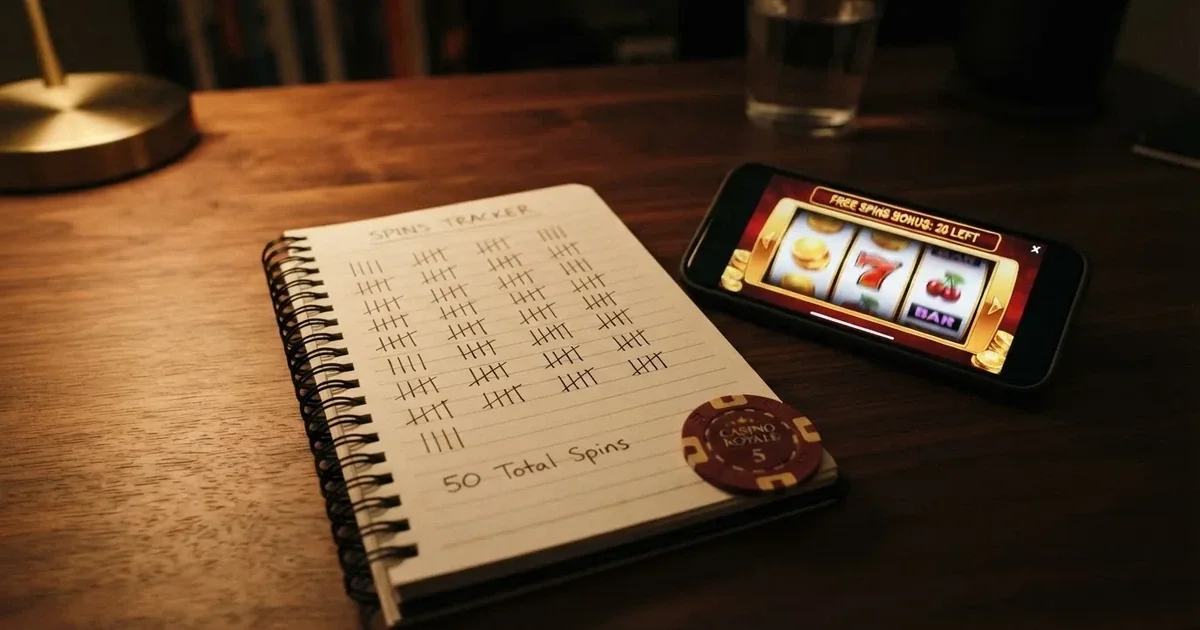
The data is current as of 10 October 2026 and was checked against the Gambling Commission’s public register of gambling businesses.
Table of Contents
- True Mechanics of a 250 Free Spins No Deposit Offer
- The Licence Behind Every 250 Spins Offer in Great Britain
- Responsible Gambling Tools That Apply to a 250 Spins Offer
- Withdrawing Winnings From a 250 Free Spins Offer
- Bonus Terms: The Real Shape of a 250 Free Spins Offer
- The 10x Wagering Cap in Practice: A Worked Calculation
- Comparing the Licensed UK Brands Side by Side
- The Choice: Where Each Player Should Land
- How the Operator Offerings Stack Up
- Picking Among the Brands: A Reader’s Path
- Frequently Asked Questions
True Mechanics of a 250 Free Spins No Deposit Offer
The mechanics of a no-deposit free spins offer have stayed consistent enough that the headline tells most of the story. An online casino credits a player’s account with 250 rounds on a named slot — usually one title, sometimes a short rotation — without requiring a deposit, a card registration, or any cash commitment beforehand. Any winnings from those rounds land as bonus funds subject to the casino’s standard bonus terms. Until those terms are met, the funds are not withdrawable cash.

That last clause is the one marketing copy tends to underplay. “No deposit” describes how the spins enter the account; it says nothing about how the winnings leave it. A £0-spin offer at 200 wagering-cap odds can produce a real-money payout that, on paper, took hours of play to clear. The same offer at lenient terms might let a player withdraw almost the full balance after a short, deliberate run. The difference is not in the 250 spins: it is in the wagering requirement, the maximum win cap, the spin value and the game weighting that ride on top of them.
UK readers sometimes meet the offer framed around a “free trial” idea borrowed from software sign-ups. It is not one. A free trial lets you decide whether to buy; a no-deposit spins offer is a fully-fledged bonus with everything that implies — capped wins, play-through conditions, withdrawal queues, game restrictions. The headline that says “free” speaks about the deposit, not the outcome.
Why the offer exists at all
Casinos do not give away 250 spins on a popular slot as charity. A no-deposit offer is an acquisition tool: it puts real slot play in front of a player who has not yet handed over card details, with the express hope that the experience is good enough to convert them into a depositing customer. The bonus terms are calibrated to that end — generous enough to look appealing, restrictive enough that the median outcome is a converted player rather than a paid-out winner.

A £0.10 spin value is the standard for entry-tier offers; 250 spins at £0.10 carry a notional bonus pool of £25, against which the wagering requirement sits. Higher per-spin values exist but are rarer, and they tend to arrive with stricter terms: lower win caps, narrower eligible games, or shorter validity windows. The shape of those terms, more than the headline number, decides whether an offer is worth a player’s time.
The Licence Behind Every 250 Spins Offer in Great Britain
Every online casino offering any gambling product to a player in Great Britain — including a 250 free spins no deposit bonus — must hold a Gambling Commission operating licence. The legal frame is the Gambling Act 2005, tightened for online operators by the Gambling (Licensing and Advertising) Act 2014 so that any operator taking UK customers, wherever it is based, needs a Commission licence. A Curaçao, Malta or Gibraltar licence alone is not sufficient.
Key Licensing Terms
| Term | Detail |
|---|---|
| Regulator | Gambling Commission (UKGC) |
| Core Act | Gambling Act 2005 |
| Licensing Act | Gambling (Licensing and Advertising) Act 2014 |
| Min. Age | 18+ |
| Verification | Pre-deposit |
The Commission maintains a public register of every business holding an operating licence, along with a separate domain list showing which websites each licence runs. On 18 September 2026 the register listed 139 businesses holding an active remote casino operating licence; the domain list carried 1,065 active entries and 361 white-label entries — sites that trade under another company’s licence rather than under their own.
For a player, that register is the most useful safeguard on the page. A licence number on the register has a specific shape: six digits naming the account holder, an “R” marking it as a remote (online) licence, a sequence of digits, and a suffix. A real licence number can be checked against the public register by anyone; a fabricated licence on an offshore site cannot, because the operator is not on it.
Why white-label matters
White-label sites are common and not inherently suspect, but they are structurally different. When a brand runs under another company’s licence, the legal counterparty for a complaint, dispute, or financial difficulty is not the brand on the homepage — it is the underlying licence-holder. Virgin Games, for example, trades under Gamesys Operations Limited; the player does not deal with Gamesys at the account level, but Gamesys is the entity the Gambling Commission regulates and the entity ultimately accountable. A player who knows their account sits inside a white-label arrangement has a clearer idea of who they are actually dealing with.
Offshore sites and what the player loses
The Commission treats providing gambling to people in Great Britain without a licence as an offence under section 33 of the Gambling Act 2005. It can issue cease-and-desist notices, push for search-engine delisting and refer cases to payment or hosting providers. It cannot, however, block sites at the ISP level within the UK. That asymmetry matters: an unlicensed site running from another jurisdiction is reachable, and an offer on it can look identical to a licensed one.
The penalty, from a player’s perspective, is not legal — it is practical. An offshore site carries no GAMSTOP integration, no obligation to honour a self-exclusion request made through the national scheme, no Commission complaints route, and no approved alternative dispute resolution. A dispute about a stuck withdrawal or a voided bonus wins in the player’s favour only if the operator chooses to cooperate. The protection a UK licence provides is not a marketing line; it is the only path through which these problems get resolved at all.
Responsible Gambling Tools That Apply to a 250 Spins Offer
A no-deposit spins offer is bound by every responsible-gambling rule that applies to a real-money bet. The licence that makes the offer legal also compels the operator to embed those safeguards, and the offer sits underneath the same controls as any other promotion on the site.
GAMSTOP self-exclusion
GAMSTOP is the national online self-exclusion scheme, and integrating with it has been a mandatory condition of every UK online gambling licence since 31 March 2020. A player who has registered with GAMSTOP cannot open a new account at a licensed operator; if they already have one, the account is suspended for the period of the exclusion. Self-exclusion can be set for six months, one year or five years; once chosen, the period cannot be cut short.
The scheme covers a 250 free spins offer exactly as it covers a £50 slot bet. There is no “promotional” exception, no trial-mode carve-out, and no opt-out for offers credited without a deposit. A player who has self-excluded cannot collect the spins; a player who has not but wants to can register before doing anything else. The decision to use GAMSTOP and the decision to claim a bonus are the same kind of decision, and the licence treats them that way.
Limits, reality checks and time-out
UK online slots carry statutory stake caps. From 9 April 2025, players aged 25 and over face a maximum stake of £5 per game cycle on online slots; from 21 May 2025, the limit is £2 for players aged 18 to 24. A game cycle includes a single spin in most slot mechanics, but the Commission defines it precisely enough that any bonus mode, free-spins retrigger or feature round running from the trigger bet also counts against the cap.
There is no Commission-set deposit ceiling, but operators must prompt every new customer to set a financial limit before their first deposit; that duty has applied since 31 October 2025. Auto-play has been banned since 31 October 2021, slot spins may not complete faster than 2.5 seconds, and the practice of presenting a win smaller than the stake as a celebratory outcome — “losses disguised as wins” — is prohibited. Reality-check reminders and time-out controls sit on top of those basics, and a player can adjust them through the account settings on any licensed site.
Financial vulnerability checks
Since 28 February 2025, licensed operators have run light-touch financial vulnerability checks at the £150 net-deposit threshold across a rolling 30 days, using publicly available data sources. The checks flag markers such as County Court Judgments or Insolvency Register entries, prompting a softer review of affordability. A wider, more thorough set of risk assessments has been signposted but is not yet in force; the £150 trigger is the active threshold players will encounter now.
A no-deposit spins offer is not a deposit, so the £150 trigger does not apply at claim-time; it applies once the player later decides to deposit, and from that point on it is a rolling measure across 30 days. A player who deposits £50 a month will never trip it; one who deposits £500 in a weekend might, even at an otherwise ordinary bankroll level.
Withdrawing Winnings From a 250 Free Spins Offer
The deposit is the easy part of the 250 free spins story; the withdrawal is where the offer actually costs time or money. The mechanics are uniform across licensed UK operators, because the bonus terms are tightly drawn and the payment rails are the standard UK set. What varies is speed, and speed is the only thing a player should be comparing between brands on this shelf.
From bonus funds to real money
Winnings from the 250 spins land as bonus funds. Bonus funds sit in a separate balance from cash; they cannot be withdrawn directly, and using them on casino games consumes them at the relevant game-weighting rate against the wagering requirement. Most slots contribute 100% of the stake value to clearing the requirement; table games and live casino typically contribute 10% or 0%; anything marked “restricted” on the bonus terms page may be excluded outright. Once the wagering requirement is met — and only then — bonus funds convert to withdrawable cash.
The conversion is gated by two caps that almost always appear together. A maximum win cap sets the ceiling on what the bonus can pay out at all, regardless of how high a balance climbs during play. A maximum stake cap limits how much can be wagered on a single round while the bonus is active, usually £5. The two are independent: a player can clear the wagering and still lose most of the resulting cash balance to the win cap; a player who respects the stake cap can still fail the wagering entirely.
The credit-card ban and what is still available
From 14 April 2020, the Gambling Commission banned the use of credit cards to fund gambling across every online and offline product in Great Britain. The ban covers credit cards routed through e-wallets, including virtual cards, and it applies to deposits, not to winnings. Debit cards, bank transfers and licensed e-wallets remain available to UK players. The Commission estimated at the time that around 800,000 UK consumers used credit cards to gamble, and that 22% of online gamblers using credit cards were classed as problem gamblers — a profile the ban is built to discourage.
The Faster Payments Service, launched in 2008 and operated by Pay.UK, is the default backbone for most UK bank transfers; it runs 24 hours a day and most payments arrive instantly or within a couple of minutes, though transfers can occasionally take up to two hours. Apple Pay, supported in the UK since 14 July 2015, layers on top of a debit card and is widely accepted at UK-licensed casinos, though its use for gambling is governed by the card’s issuing bank as well as by the casino. AstroPay’s UK entity is an FCA-authorised electronic money institution, and it offers a similar wallet-style option alongside Apple Pay for players who prefer not to enter card details directly.
What “instant withdrawal” really means at a licensed site
A licensed UK casino that advertises instant withdrawals is usually relying on Faster Payments rails for the bank-transfer path, on Visa Direct or its Mastercard equivalent for debit cards, and on a payment provider’s own wallet-to-wallet flow for e-wallets. The destination bank then decides the final speed: a UK high-street bank will credit inside minutes on Faster Payments, a building society or a smaller challenger may take up to two hours, and a few still batch payouts. None of these rails is specific to gambling; the operator’s job is to release the payment on its side at the moment a withdrawal is requested.
Know-your-customer verification sits in front of the first withdrawal. Name, address and date of birth have to be confirmed before any payout, and the rules tightened in May 2019 mean the verification has to happen at the deposit stage rather than after a win. A player who is fully verified at the moment of claiming a no-deposit spins offer and who keeps their card or bank details up to date will, in nearly every case, see a withdrawal cleared inside hours once the bonus terms are met.
Bonus Terms: The Real Shape of a 250 Free Spins Offer
The promotional headline is “250 free spins no deposit”. The mechanism is closer to a structured product with five moving parts — and it is the parts, not the headline, that decide what the offer is worth. A reader who reads the headline alone ends up at the wrong conclusion; a reader who reads the small print ends up with a clearer view of the offer than the average comparison page provides.
Spin value
Each of the 250 spins will be played at a fixed stake, almost always £0.10 for entry-tier offers. The notional bonus pool is the spin value times the number of spins — £25 for the standard entry. The figure matters because the wagering requirement is usually expressed as a multiple of the bonus, the deposit, or the bonus-plus-deposit total, and a £25 notional pool carries less wagering than a £50 one does, even at the same multiple.
Wagering requirement and the 10x ceiling
Since 19 December 2025, the Gambling Commission has capped wagering requirements on casino bonuses at 10x. The cap applies to the bonus alone, the deposit alone, or the bonus-plus-deposit combination depending on the offer type. A 10x multiplier on a £25 notional bonus means £250 of qualifying wagering; the same multiple on a £100 deposit-gated bonus would mean £1,000 of qualifying wagering. The cap is the most material change to UK bonus terms in years, and it has reshaped what a “reasonable” offer looks like at every tier.
Mixed-product bonuses — promotional structures where, for example, a sports bet unlocks casino spins — were banned alongside the wagering cap. The aim is to make bonus terms transparent at the point of claim rather than at the end of a long conditional chain. A 250 spins offer in 2026 sits inside a market where 10x is the ceiling and mixed-product hooks are no longer permitted; readers comparing offers across jurisdictions should remember that.
Game weighting and eligible slots
Slot play contributes 100% to most wagering requirements; live casino and table games contribute a reduced percentage or nothing at all. The 250 spins will be eligible on one named slot or on a small rotation; using them on any other game is usually treated as a breach of the bonus terms and can void the bonus balance. This is a strict eligibility check, not a soft suggestion: it is enforced by software, not by a human reading the play history.
Maximum win and maximum stake caps
A maximum win cap is the lever that converts a generous-looking wagering requirement into a hard ceiling. Common caps run from £50 to £500 on no-deposit spins offers; some are uncapped, but those are rare in a 10x-cap world. The cap sits on the bonus, not on the player’s skill — even the cleanest run on a high-volatility slot will surrender anything above the cap. A stake cap, usually £5, sits alongside it and governs how the wagering is cleared.
Validity windows and forfeiture
The 250 spins are normally credited as a single batch with a fixed validity window, often seven days from credit. Spins unplayed at expiry are forfeit; winnings generated in the window become bonus funds and begin their own clock against the wagering requirement; the winnings’ wagering window is often 30 days from credit. A player who does not clear the wagering inside that window loses the bonus balance entirely. The two clocks — one for the spins, one for the wagering — are independent, and either running out is enough to forfeit the bonus.
The 10x Wagering Cap in Practice: A Worked Calculation
The 19 December 2025 cap on wagering requirements is the kind of rule that reads abstractly until it is priced through a real offer. The point of running a number here is to show what 10x actually buys — the turnover a player has to put through the bonus balance, the spin-load that turnover represents on a £0.10 spin, and the estimated hours of play it translates to.
Take the standard 250 free spins no deposit offer at £0.10 per spin. The notional bonus pool is 250 × £0.10 = £25. A 10x wagering requirement on the bonus alone produces a turnover of £25 × 10 = £250 of qualifying wagering. Divide that turnover by a £0.10 per-spin stake and the bonus requires 2,500 slot spins to clear. Those spins do not run at unlimited speed: minimum spin interval of 2.5 seconds on UK-licensed slots means a continuous-run minimum play time of 2,500 × 2.5 seconds = 6,250 seconds, or roughly 1 hour and 44 minutes of uninterrupted slot play.
A more generous-but-still-cap-compliant offer might credit £0.20 per spin, raising the notional bonus pool to £50 and the turnover at 10x to £500. That, in turn, doubles the spin load to 5,000 spins and the minimum clear-time to about 3 hours and 28 minutes. A heavier wagering multiple — at the cap’s old edges of 30x or 40x, before 19 December 2025 — would have stretched the same offer past a working day of slot play; at 10x, it sits inside an afternoon. The cap is not a complete rewrite of the offer, but it has compressed the time required to clear a typical spins bonus by roughly a factor of three, and the change is visible to anyone willing to do the arithmetic on a casino’s terms page.
The figure that matters most to the player is not the time but the implied cost: any slot spin is a bet against the house edge. The £250 turnover on a slot at the industry-typical RTP for a featured game is the offer’s real exposure to chance, and that exposure — rather than the wagering multiple — decides whether the 250 spins are a free trial of a product or a slightly discounted bet against an RNG.
Comparing the Licensed UK Brands Side by Side
The comparison that follows is built from the Gambling Commission’s public register, not from promotional copy. Every row is a brand licensed for remote casino play in Great Britain at the moment of writing; the columns are the ones that change a reader’s decision, and only those. No-data cells, marked with an em dash, are filled where research has no verified figure — a deliberate gap rather than a guess.
The licensed landscape
| Brand | Licence holder and GB remote casino licence | Domain status on the register | Subject support |
|---|---|---|---|
| Paddy Power | PPB Games Limited · 039411-R-319335-010 | Active | — |
| Betway | Betway Limited · 039372-R-319367-029 | Active | — |
| Virgin Games | Gamesys Operations Limited · 038905-R-319430-022 | White label | — |
| Unibet | Platinum Gaming Limited · 045322-R-324275-019 | Active | — |
| 888casino | 888 UK Limited · 039028-R-319297-014 | Active | — |
| Midnite | Dribble Media Limited · 042647-R-321653-022 | Active | — |
| PokerStars | Stars Interactive Limited · 039108-R-319334-026 | Active | — |
| William Hill | WHG (International) Limited · 039225-R-319373-015 | Active | — |
| Ladbrokes | LC International Limited · 054743-R-330863-014 | Active | — |
| BetVictor | BV Gaming Limited · 039576-R-319370-028 | Active | — |
The story the table tells is consistent across every cell. Each of these brands holds a current Gambling Commission remote casino operating licence; each domain is on the register in the status shown, on the date shown. The Subject support column is empty across the board because the page’s promotional subject — 250 free spins no deposit — is not a feature these brands advertise in their public-facing registration data. A reader who sees an offer for 250 spins on any of these brands should expect the offer’s terms, not the licence register, to describe what the spins do. The register proves the brand may make the offer; the terms page decides whether the offer is worth claiming.
The white-label entry — Virgin Games trading under Gamesys Operations Limited — is the only structural variation in the table. It matters operationally for dispute resolution and accountable ownership, even though it does not change the player experience in any visible way.
How to read the spread
A reader who treats the licence register as a quality ranking will reach the wrong conclusion. The register is a compliance document, not a player guide: being on it is necessary, not sufficient. What makes one of these brands more suitable than another, for any given player, is the cluster of factors that sit beyond the licence — slot portfolio, payment-rail coverage, withdrawal speed on a real win, mobile experience, customer support after a problem. The table does not speak to those, because no public source records them in a comparable form and an editor should not invent one.
A reader who treats the licence register as a club to participate in, on the other hand, has reached exactly the right conclusion. The 139 businesses on the register are the only operators licensed to take a UK real-money bet online; the 1,065 active domains and 361 white-label domains are the websites those businesses run. Every casino brand that runs a 250 free spins no deposit offer to a UK player is on the register; every brand that runs such an offer to UK players from an offshore base is not, and the player on the offshore site has none of the protections — GAMSTOP, ADR, Commission complaints — that a licensed site is required to provide.
The Choice: Where Each Player Should Land
The “choice” frame is not about which brand is “best”; it is about which brand is right for which player, and that depends on what the player actually values in a no-deposit spins offer. Each profile below picks a different priority, and the corresponding shortlist of brands narrows accordingly.
The reader who values brand trust above all
Players who decide on the basis of name recognition tend to land on Paddy Power, William Hill, Betway or Ladbrokes. These are the largest of the 139 licence-holders by retail presence, and their long UK histories carry through into the online product. The licence conditions that govern their slots, bonuses, withdrawals and complaints are the same as for any other brand on the register; the difference is operational scale, which shows up in customer support staffing, in the depth of a slot catalogue, and in the speed with which a flagged withdrawal clears. A first-time player who wants the most coverage and the most familiar complaints path will usually default here.
The reader who values a clean, modern product
Players who want the newest slot portfolio and the most contemporary UI often find Midnite or BetVictor a closer fit than the larger incumbents. Midnite’s licence-holding entity — Dribble Media Limited — is a smaller operation that has built a product around newer studios; BetVictor’s licence-holding BV Gaming Limited has rebranded the casino product twice in the last several years and now sits closer to the modern end of the industry than to the legacy bookmaker end. These brands trade some of the brand-recognition premium of the larger names for cleaner mobile play and a tighter slot library.
The reader who values a specific game or studio
A player who has a specific slot in mind — a particular Pragmatic Play title, a Hacksaw release, a Nolimit City game — should check the studio’s official distribution list before committing, rather than browsing casino lobbies. Slot distribution in the UK is studio-led: a casino’s library is, in practice, the studios it has commercial relationships with. The licence register does not record those relationships, and a slot brand does not sit on the register; a player chasing a specific game will settle on whichever casino licensed in the UK carries that studio at the time. This is one of the few decisions the register does not help with.
The reader who values withdrawal speed
The licence register does not record payout time either. Faster Payments supports most UK bank withdrawals within minutes or up to two hours; UK debit card payouts depend on Visa Direct and the issuing bank; e-wallet payouts depend on the wallet provider’s own rails. A player who has had a withdrawal stuck in slow queues before — and that experience is more common on legacy operators than on newer ones — will lean toward operators with a track record of releasing funds on the same day. This is one of the few areas where community reports and recent complaint histories add to what the register shows.
How the Operator Offerings Stack Up
The operator reviews that follow are not endorsements; they are notes on what the licence data, the public structure and the regulatory framing say about each brand, and where each one sits when a reader asks a specific question.
Paddy Power
Paddy Power trades from Paddy Power under PPB Games Limited (account 39411), which holds remote casino operating licence 039411-R-319335-010 on the Gambling Commission’s register; the domain is listed as active at the time of writing. The brand is one of the largest UK-licensed operators by retail-footprint, and its online casino carries the operational depth that scale produces: a broad slot library, a well-staffed complaints pathway, and rapid payouts on standard payment rails. Paddy Power is, in practice, what most readers think of when they think “mainstream UK casino” — and the register confirms the brand’s structure rather than adding new marketing to it. The site’s evolving product direction occasionally runs ahead of its identity: it is, by nature, an incumbent.
Betway
Betway is held by Betway Limited (account 39372) under licence 039372-R-319367-029, with the domain listed as active on the register. The brand’s casino product is built around an international sporting profile, but the UK remote casino licence it holds covers the full online offering rather than being sport-specific. Betway is one of the operators most likely to be already familiar to a reader — a name that came up most often in mainstream sports coverage over the past decade — and the licence data backs up what that familiarity implies about regulatory standing. A reader’s verdict here tends to track prior brand comfort rather than the bonus terms.
Virgin Games
Virgin Games trades from Virgin Games under Gamesys Operations Limited (account 38905), with remote casino licence 038905-R-319430-022; the domain appears on the register as a white-label entry rather than as an active domain in its own right. White-label status does not change the player experience, but it does mean that any complaint, dispute or regulatory action is formally addressed to Gamesys Operations Limited rather than to the Virgin brand. Virgin Games’ product sits inside the Gamesys platform family, which gives it a distinctive slot and bingo portfolio but places it under a less direct licence relationship than its peers. The trade is well-understood and well-managed; a player who values the Gamesys catalogue specifically will find it here, and a player who values direct brand ownership of the licence will pick a brand whose domain sits as active rather than white-label.
Unibet
Unibet’s UK presence runs through unibet.co.uk, on the register under Platinum Gaming Limited (account 45322) and licence 045322-R-324275-019, with the domain listed as active. The .co.uk domain is distinctive at this level of the UK market and reflects the longer history of online gambling in the country, where UK-licensed brands often kept a .co.uk even as competitors moved to .com. Unibet’s product depth — sportsbook, casino, poker under a single licence-holder — produces a coherent integrated platform, and the licence authority is solid. A reader who wants an all-in-one account rather than a casino-specialist one will land here naturally.
888casino
888casino trades from 888casino under 888 UK Limited (account 39028) and licence 039028-R-319297-014, with the domain listed as active. The 888 group’s product is the reference point for several proprietary slot mechanics on the UK market — a casino-originator’s catalogue rather than a slot aggregator’s. A player who already knows what they like inside the 888 portfolio often finds the brand self-selecting: there is a 888 style that is consistent across the group’s products, and the experience is anchored to it. The licence position is straightforward and well-supported, and the product differentiation is one of the easier ones for a reader to identify on their own.
Midnite
Midnite operates under Dribble Media Limited (account 42647) and licence 042647-R-321653-022, with the domain listed as active on the register. Midnite is one of the newer UK-licensed brands, and its product reflects that — modern UI, a slot portfolio skewed to newer studios, fewer legacy table products than the larger incumbents. The licence is solid and the operator meets every Commission obligation, but the brand does not yet have the multi-decade operating record of the largest groups. Midnite suits a reader who specifically wants a newer product and who is comfortable with the operational maturity profile that comes with it.
PokerStars
PokerStars Casino runs through PokerStars, on the register as Stars Interactive Limited (account 39108) under licence 039108-R-319334-026; the domain is listed as active. The .uk domain is, like Unibet’s .co.uk, a deliberate choice rather than a constraint; PokerStars’ UK arm sits inside a separate licence-holder from the international PokerStars product, which matters for dispute resolution and for any cross-border question a player might raise. The casino product lines up well with the broader Stars offering — slot product, live casino, sportsbook-adjacent functionality — and the regulatory standing is exactly what a reader would expect from a brand of that scale.
William Hill
William Hill trades from William Hill under WHG (International) Limited (account 39225) and licence 039225-R-319373-015, with the domain listed as active. William Hill’s UK history runs back into the retail bookmaking era, and the licence data confirms the brand’s online casino has the institutional standing most readers assume when they encounter the name. The product set is comprehensive: casino, slots, live casino, sportsbook, all under one licence-holder. A reader whose trust hierarchy runs through brand history will short-list William Hill early, and the register data does not contradict that conclusion.
Ladbrokes
Ladbrokes operates from Ladbrokes under LC International Limited (account 54743) and remote casino licence 054743-R-330863-014, with the domain listed as active. The licence-holder, LC International Limited, also covers Coral and Gala Bingo — a shared-licence structure that is common among the legacy UK groups. The presence of three retail brands under one licence has no direct cost to a casino player, but it does mean that a Ladbrokes customer who escalates a complaint reaches the same regulatory counterparty as a Coral or Gala Bingo customer. A reader who treats Ladbrokes, Coral and Gala as three independent operators is mistaken about the structure, even though each presents itself under its own brand.
BetVictor
BetVictor trades under BV Gaming Limited (account 39576) and remote casino licence 039576-R-319370-028, with the domain listed as active on the register. BetVictor’s product has moved closer to the modern end of the casino spectrum over several rebrands, and the licence-holder’s UK focus has produced an operator with no cross-border complications in its UK offer. The brand sits in the same general category as Midnite on age and product modernity — newer studios, cleaner mobile play — while carrying somewhat more operating history. A reader who values a contemporary product over a 20-year name will often short-list BetVictor alongside Midnite.
Picking Among the Brands: A Reader’s Path
The licence register answers one question well and several poorly. The first decision — whether a brand is licensed at all — is settled by the table above and the register it points to. The second decision — what the brand actually feels like to use — is not on the register and not on this page either; only direct trial answers it. The third decision — whether the 250 spins offer is worth claiming — sits in the bonus terms the operator publishes at the point of claim, and it changes enough between brands that a recurring offer on one site is a one-off on another.
The path that lands in the right place for most readers is the same. Verify the licence against the register; read the bonus terms in full before claiming; understand the wagering, the win cap and the validity window; decide whether the offer is worth the play-time and the exposure; if it is, claim the spins with verification already complete. The comparison the register enables — that these ten brands hold an active licence, with the structural variations shown — narrows the rest of the decision. The rest of the decision is the player’s to make.
Frequently Asked Questions
What does 250 free spins with no deposit actually mean?
A casino credits a new or eligible account with 250 spins on a named slot, without taking any deposit first. The spins land as bonus rounds, and any winnings convert to bonus funds subject to the operator’s wagering rules. Cash is not in the account at the point of claim — the “no deposit” phrase describes the entry condition, not the withdrawal.
Are there wagering requirements on winnings from 250 free spins?
Yes. UK operators must apply a wagering requirement to convert bonus winnings to withdrawable cash, and that requirement is capped at 10x the bonus amount from 19 December 2025. Players convert only the amount cleared by the cap and the bonus terms governing game weighting. Wagering is the central mechanic of any no-deposit spins offer.
Is there a maximum win cap on 250 no-deposit free spins?
Most operators apply a maximum win cap that limits how much of the bonus balance becomes withdrawable after the wagering is cleared. Common caps run from £50 to a few hundred pounds, and the exact figure is set by the operator’s terms. The cap is independent of skill: a clean run on a high-volatility slot still leaves anything above the cap behind.
Does GAMSTOP self-exclusion cover a 250 free spins offer?
GAMSTOP integration is mandatory for every UK-licensed online casino, and the scheme covers bonus offers of every kind, including no-deposit spins. A self-excluded player cannot claim a 250 free spins offer any more than they can place a £5 slot bet. A player who has not registered with GAMSTOP but wants to do so can register before claiming; the exclusion periods run six months, one year or five years.
How long do 250 no-deposit free spins stay valid once credited?
Validity windows vary by operator, but a typical structure gives 7 days to use the spins and a longer window — often 30 days — to clear the wagering on any bonus winnings. Unused spins expire at the first deadline; uncleared bonus funds expire at the second. Both windows are set by the operator’s bonus terms and are stated on the offer’s terms page.
Must a casino be licensed by the Gambling Commission to offer 250 free spins with no deposit to UK players?
Yes. Under the Gambling Act 2005 and the Gambling (Licensing and Advertising) Act 2014, every operator taking UK customers in Great Britain needs a Gambling Commission operating licence; a Curaçao, Maltese or Gibraltar licence is not a substitute. The public register of gambling businesses is the authoritative test of whether a brand holds a licence, and the licence is the only route through which a UK player has access to GAMSTOP, ADR and Commission complaints.
Created by the ”signupbonuscheck” editorial team.